Serious Sellers Podcast: Free Amazon FBA Learning Guide

In this guide
The quick answer
What is the Serious Sellers Podcast?
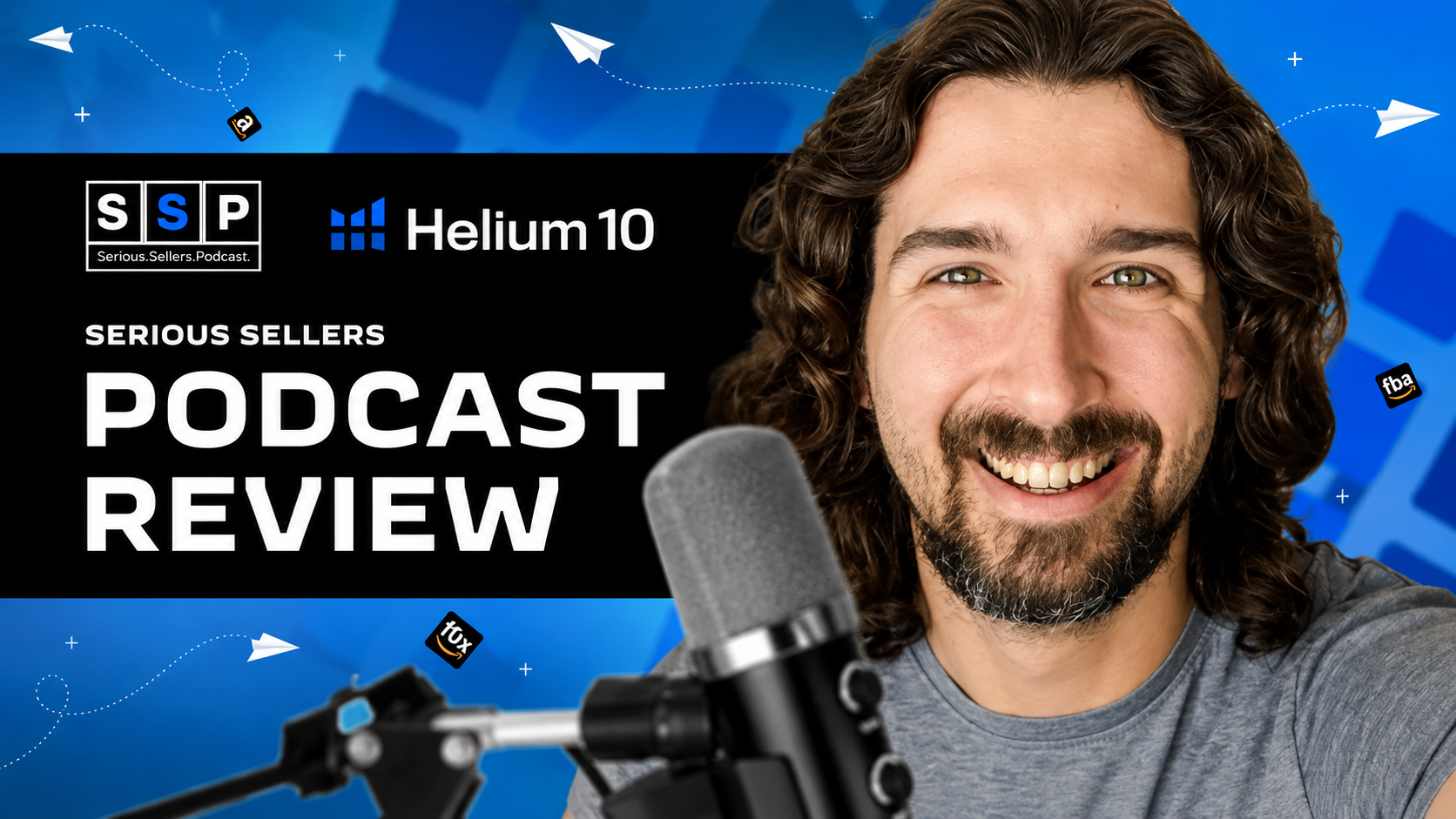
The Serious Sellers Podcast by Helium 10 is a free ecommerce podcast hosted by Bradley Sutton. It features conversations with sellers and specialists about building online businesses, including selling on Amazon, Walmart, and TikTok Shop. Listen for ideas, practical examples, and questions you can investigate in your own business.
Learning Amazon FBA can feel like opening twenty browser tabs and discovering that each one recommends something different. One person talks about product research, another focuses on advertising, and somebody else says your listing images need work. Where do you begin?
I like podcasts because they let you hear the reasoning behind a decision. A tutorial can show where to click. A good conversation can explain why a seller chose that approach, what went wrong, and what they would consider differently.
In the video below, I introduce the Serious Sellers Podcast and discuss how podcasts became part of my learning journey. This guide expands on that introduction with listening options and a practical way to turn an episode into a useful next step.
Affiliate disclosure: Some links are affiliate links. If you purchase through them, I may earn a commission at no extra cost to you. Read my full disclosure.
Why I recommend learning from seller conversations
I have been selling on Amazon since 2016, and my aim here is to make the learning process easier to navigate. You do not need to understand every tool or master every strategy before taking a sensible first step. You do need to ask better questions as you go.
That is where a seller interview can help. Instead of seeing only the finished result, you hear about decisions along the way. A discussion about choosing a supplier might reveal a quality problem. A conversation about advertising might uncover a weakness in the product page.
I have also been a guest on the show. In episode 240, published in May 2021, Bradley spoke with Wayne and me about our Amazon journeys. The episode covers topics including advertising, fulfillment, and using tools across language barriers. It is one example of how people with different backgrounds can encounter similar business questions.
When you listen, look for the decision behind the story. What information did the guest have? What limitation were they working around? Which part might apply to you? Those questions are more useful than comparing your starting point with somebody else’s headline result.
Helium 10 discounts for your next step
The podcast is free to access. If you also decide to use a paid Helium 10 subscription, these are my two discount options:
VOVA6M20
20% OFF your first six months. An introductory discount on an eligible subscription.
VOVA10
10% OFF every month, for life. A recurring discount while your eligible subscription remains active.
Check eligibility, renewal pricing, and the applied discount at checkout. “For life” describes the recurring discount; it does not mean a one-time purchase of lifetime software access.
Explore Helium 10 discountsWhat can you learn from the Serious Sellers Podcast?
The show’s archive combines seller experiences with discussions about running and growing an ecommerce business. Helium 10’s current podcast hub also points readers to Weekly Buzz for industry updates. Choose a business conversation when you want context, and a news episode when you want to investigate a recent development.
For Amazon sellers, I would organize your listening around the decisions in front of you. The table below is my suggested learning map, rather than a fixed curriculum or a promise that every episode covers each subject.
| Your question | Topic to look for | Useful takeaway |
|---|---|---|
| What could I sell? | Product research and differentiation | A customer problem to investigate |
| Why do shoppers hesitate? | Listing content and images | One product detail to explain better |
| What should I examine in my ads? | PPC and search terms | A question for your campaign review |
| How could my operations improve? | Inventory, fulfillment, and systems | A recurring task worth documenting |
| What has changed recently? | Marketplace news | An update to verify at its original source |
Notice that none of these takeaways requires copying another seller’s entire business. You can learn from a large brand while working on a small catalog. The useful part may be its method for gathering customer feedback, rather than its advertising budget or team structure.
For example, if a guest explains how clearer product images helped shoppers understand an item, your next step could be reviewing whether your own images answer basic questions about size, contents, and use. You still need evidence before deciding that an image change will improve your results.
Where can you listen to the Serious Sellers Podcast?
Start with the official Helium 10 podcast hub or the show’s public episode feed. These give you a reliable starting point for finding the program and choosing an episode. You can also listen through Apple Podcasts and Spotify, or look for video episodes on Helium 10’s YouTube channel.
Listen in your browser
Browse episode descriptions, choose a topic, and use the public audio player.
Open the episode feedUse your podcast app
Follow the show in the app you already use so it is easy to find again.
Apple PodcastsAudio works well when you can give the conversation attention without needing a screen. Walking or doing a simple household task can be a convenient opportunity. For a discussion involving charts or software screens, watching the relevant Helium 10 YouTube video may make the explanation easier to follow.
Before pressing play, read the description and check the publication date. Where an episode includes timestamps or a written transcript, use those to find a section you want to revisit. You do not have to replay an entire conversation to recover one useful point.
If the conversation feels too fast, use your listening app’s playback controls where available. Pause for unfamiliar terms and return to them later. Understanding a short section is more useful than finishing a long episode without knowing what the advice means.
If English is not your first language, keep a small vocabulary list connected to your current task. For example, write down PPC as pay-per-click advertising and FBA as Fulfillment by Amazon. Then describe each term in your own words. You do not need perfect English to benefit from an interview, but you should understand the terms behind any action you plan to take.
How to choose an episode for your stage of selling
My starting rule is simple: choose the episode that helps with your next decision. An impressive revenue figure in a title may catch your attention, but relevance matters more. Your time is limited, and every extra topic competes with work you already need to finish.
If you have not launched a product yet
Look for conversations about customers, product selection, differentiation, and the realities of launching. Keep a list of assumptions you need to investigate. Avoid treating a guest’s product choice as a ready-made recommendation for your own first order.
If you already have a listing
Choose a topic connected to a specific problem you can observe. For example, unclear product information is a different question from inconsistent stock availability. Describe the problem first, then search the archive for a relevant discussion.
If you manage an established business
Look for ideas about repeatable processes, team responsibilities, reporting, or expansion. Ask whether an approach would remove a real constraint in your operation. A new channel or tool should have a clear purpose before it becomes another responsibility.
You can also keep two short queues: one episode for a current business problem and one for broader perspective. That gives curiosity some room without letting interesting interviews replace necessary work. If a topic does not fit your current stage, save it and move on.
Think about the format you need, too. A seller interview is useful for understanding choices and tradeoffs. A focused tutorial is often easier when you need to complete a particular task on screen. A structured course can help when you need an ordered foundation. These resources can support each other; the right choice depends on what you are trying to learn today.
Turn one podcast episode into a practical action
Listening is easy to measure: you finished an episode. Learning is harder to measure until you use it. I recommend a small routine that connects the conversation to your own decisions without turning every idea into an urgent project.
- Write your question before listening. Give the episode a job. “I want to understand which customer questions my listing misses” is more useful than “I want to get better at Amazon.”
- Save one idea and its context. Note the episode title, date, timestamp, and what the guest was trying to achieve. Record relevant limitations, such as the marketplace, product type, or resources involved.
- Check the underlying claim. If the idea depends on a platform rule, software feature, or specific fee, verify the current information before acting. An interview is a starting point for research.
- Choose a manageable next step. You might inspect customer questions, document an existing process, or compare two reports. Start with something that helps you understand the situation before making a larger change.
- Review what happened. Record what you learned and whether another step is justified. Keep track of other changes that could affect the result, so you do not automatically credit the podcast idea.
My question → Episode and timestamp → Useful idea → What I verified → Next action → Review date.
Here is an illustrative example. Suppose you hear a seller discuss reducing confusion about product dimensions. You review your own listing and notice that the measurements are difficult to find. Your first action could be documenting the missing information and checking the applicable image requirements before preparing a clearer visual.
That is a concrete outcome from listening. You have identified something to investigate and a reason for doing so. You have not assumed that another seller’s results will transfer to your product, or that changing several things at once will teach you what worked. Keep that note somewhere you will actually revisit when you resume the task.
Keep useful ideas in context and avoid information overload
A large episode archive can become another source of unfinished homework. You save interviews, collect tips, and feel behind because there is always more to learn. I would rather you finish one useful investigation than build a playlist you never have time to apply.
The show itself has addressed this problem. Episode 316 discusses information overload and the challenge of choosing among courses, groups, podcasts, and other resources. It is a useful older discussion to explore when learning starts to crowd out doing.
Keep the age of an episode in mind. A story can remain interesting years later, while a software interface, marketplace policy, or promotional offer may have changed. Separate the general lesson from details that need a fresh check.
Also remember who publishes the show. Helium 10 produces it, so its software naturally appears in the conversation. You can learn from the discussion while independently deciding whether a product fits your needs. Listening does not require buying every tool mentioned.
Finally, a guest’s experience describes that guest’s circumstances. Their budget, category, timing, and existing audience may differ from yours. When a result sounds exciting, ask what conditions made it possible and what evidence you would need before trying a similar approach.
For a team, share the relevant timestamp with a short explanation of why it matters. Assign somebody to investigate the idea before turning it into a new process. This keeps a useful conversation from becoming an unclear instruction, and gives everyone a chance to identify missing information before work begins.
Ready to explore the Helium 10 tools?
If a podcast episode introduces a tool you want to try, first check whether its features match your actual task. My offers are below, and you can compare them in the Helium 10 coupon guide.
VOVA6M20
20% OFF your first six months. An introductory discount on an eligible subscription.
VOVA10
10% OFF every month, for life. A recurring discount while your eligible subscription remains active.
Check eligibility, renewal pricing, and the applied discount at checkout. “For life” describes the recurring discount; it does not mean a one-time purchase of lifetime software access.
Explore Helium 10 discountsSerious Sellers Podcast: common questions
Is the Serious Sellers Podcast free?
Yes. You can access public episodes through the official podcast pages and supported listening platforms without buying a Helium 10 software subscription. A podcast app may have its own account requirements or optional paid services.
Who hosts the Serious Sellers Podcast?
Bradley Sutton hosts the show. Helium 10 publishes it, and episodes feature conversations with ecommerce sellers and specialists. Check the individual episode description for the guests and subject.
Is it suitable for beginners?
Yes, provided you choose relevant episodes. Start with seller journeys and topics related to understanding customers or preparing a product. Advanced advertising or expansion discussions may be more useful after you have a specific problem to solve.
Do I need a Helium 10 account to listen?
You do not need a paid Helium 10 account to listen to the public podcast. Access to software features discussed in an episode is a separate matter and depends on the relevant product and plan.
Should I listen to every episode in order?
There is no need to work through the entire archive chronologically. Pick a topic connected to your current question, check its date, and review the description. Return to other episodes when they become relevant.
Can I rely on an older episode for current instructions?
Use older episodes for background and ideas, then verify details that can change. This is especially useful for software walkthroughs, marketplace requirements, and discounts. The original publication date helps you judge what needs checking.
Start with one question and one episode
If you are looking for an Amazon FBA podcast, the Serious Sellers Podcast is a practical place to explore seller experiences and business ideas. My recommendation is to give your first episode a clear purpose: choose something you want to understand, listen carefully, and record one useful next step.
You can keep learning through my Helium 10 free account guide or browse the Amazon seller tutorials on my blog when you want a more focused walkthrough. Let your current task guide what you open next.
You do not need to finish the internet before getting started. Find a useful question, give it some attention, and build from what you learn. Enjoy the listening!
Vova :)