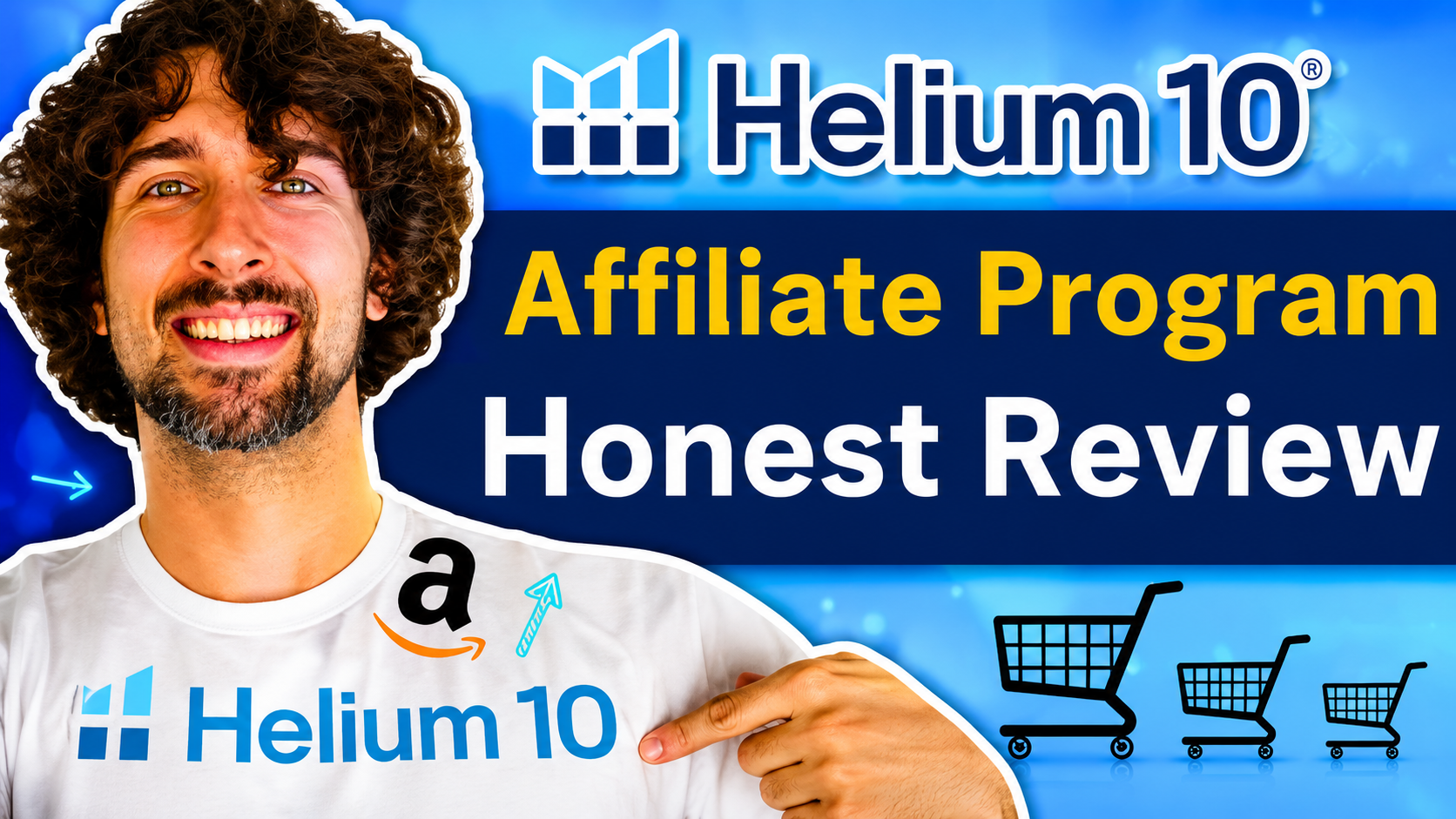
Helium 10 Affiliate Program Review: Is It Worth Joining?

In this guide
The quick answer
Is the Helium 10 affiliate program worth joining?
The Helium 10 affiliate program is worth considering if you help Amazon sellers understand software and make better buying decisions. Joining is free, but earning requires relevant content and qualified referrals. My experience has been positive. However, the older lifetime commission model described in my original review should not be confused with the current tiered offer.
A commission percentage can make an affiliate program look attractive. What matters more to me is whether I can recommend the product honestly, explain its purpose clearly, and help someone use it after signing up. That is the perspective behind this Helium 10 affiliate program review.
In my original review, published in October 2024, I reported more than five years in the program and over $100,000 in cumulative affiliate earnings. Those were historical, self-reported results across several years. They are not a current earnings update, a monthly income figure, or a prediction of what another affiliate will earn.
Below, I explain what I valued about the relationship, how the published commission structure has changed, and how I would approach creating useful content around the software today.
Affiliate disclosure
The application links below are referral links. If you join through my link and qualify under the referral arrangement, I may receive a bonus at no extra cost to you. Read my full earnings disclosure.
Apply to the Helium 10 affiliate program for free
What I liked about being a Helium 10 affiliate
My original review highlighted the affiliate managers, promotional resources, and the opportunity to earn through education. I had worked with several managers and appreciated having people I could contact for guidance. That support made the relationship feel more collaborative.
For me, the practical value of a manager is having somewhere to take specific questions. Before publishing an offer, I would rather clarify which audience it suits, which terms apply, and whether the details are still accurate. That helps prevent avoidable corrections later.
Helium 10’s official affiliate overview also describes manager support, custom discount codes, landing pages, and training resources. I would treat these as tools to improve communication, while still doing my own research and checking each recommendation.
What appeals to me
Useful software gives you concrete subjects to teach. A clear demonstration can answer a real seller question and give the viewer a reason to explore further.
What takes work
You need to learn the tools, produce understandable content, and maintain it. A referral link alone gives people very little reason to trust your recommendation.
How do Helium 10 affiliate commissions work now?
The published model uses Bronze, Silver, and Platinum tiers. The table summarizes the monthly-plan structure described in Helium 10’s official materials, checked on October 27, 2026. Your active tier and the eligibility rules matter when interpreting the headline percentages.
| Tier | Monthly referral threshold | Upfront commission | Recurring component |
|---|---|---|---|
| Bronze | 0–10 new subscribers | 100% of first payment | None |
| Silver | 11–50 new subscribers | 100% of first payment | 25% for 12 months on eligible referrals |
| Platinum | 51+ new subscribers | 125% of first payment | 25% for 12 months on eligible referrals |
Under the current program FAQ and agreement, recurring eligibility excludes the first ten new monthly subscribers. Qualifying recurring payments begin in month two. Tier qualification is assessed monthly, with changes taking effect the following month. Annual subscriptions pay a one-time 25% commission.
The useful question is how your particular referral will be classified. Keep the customer’s billing choice, your active tier, and the commission status together when reviewing results. That is more informative than applying the highest advertised rate to every signup.
When do affiliates get paid?
Helium 10’s affiliate welcome page lists monthly payments on the first, a $150 minimum payout, Tipalti processing, and a 60-day period before payout. Confirm the schedule applicable to your account because that page also contains older commission wording.
I would separate three numbers in my records: commissions displayed, commissions approved, and money received. They answer different questions. An amount appearing in a dashboard does not necessarily mean it is ready to withdraw or already available to spend.
For example, if your account uses a $150 threshold and the eligible balance is $120, you have not reached that threshold. This is a simple illustration of the payment condition, not a statement about your balance or a promised payment date.
Before relying on affiliate revenue for an expense, check the approved balance and payment details. If something looks unclear, send your manager the relevant dates and transaction references. A specific question is easier to resolve than a general message saying the numbers look wrong.
Who is this affiliate program a good fit for?
I would look at audience fit before follower count. Someone teaching Amazon product research has a natural reason to discuss seller software. A creator whose audience has no interest in ecommerce has a much bigger gap to bridge, even with a large following.
Useful starting points include tutorials for new sellers, workflow demonstrations for existing businesses, and carefully researched software comparisons. The common thread is an audience with a question that the software can help answer.
Helium 10 says you do not have to sell on Amazon to participate. Still, I would learn the workflow before teaching it. If you are new, describe what you tested, what you observed, and where your experience ends. Readers can work with honest limits.
My practical test is simple: could I create a useful explanation about this tool even without including an affiliate link? If the answer is yes, there may be a good content opportunity. If the only interesting point is the commission, I would reconsider the angle.
How to join the Helium 10 affiliate program
Start with the free Helium 10 affiliate application. The official signup currently uses Impact. Follow the registration instructions and check your account status before publishing referral links.
- Describe your audience clearly. Explain who you help, where you publish, and what kind of content you intend to create. Use accurate information about your existing channels.
- Read the account terms. Save the agreement you accept and note the commission rules, attribution information, and payment requirements relevant to your participation.
- Confirm your referral assets. Locate your assigned link and any approved promotional materials. Ask your manager about details you cannot verify in the dashboard.
- Prepare one useful piece of content. Choose a narrow question, demonstrate the answer, and place your disclosure and relevant link where readers can understand them.
Keep a record of the page where you placed each link. When an offer changes, that small habit makes it easier to update your descriptions, articles, and other references consistently.
Before publishing your first campaign, I would ask the affiliate manager several focused questions: Which referrals qualify for my current offer? Where can I see the attribution window? How are refunds reflected in reporting? Which promotional materials are approved for my channel? Where will changes to my agreement be communicated? Keep the answers with your campaign notes so you can refer back to them. If a public page and your account display different information, clarify the difference before making a claim to your audience. This preparation also helps when you return to an older article. You can compare what you originally checked with the current offer and update the affected passage, instead of rewriting everything or leaving a misleading promise online. Treat accuracy as part of the reader experience from day one.
My approach to useful affiliate content
I would start with a seller’s question and work backward to the demonstration. For example, a viewer might want to understand why two product ideas deserve different levels of investigation. A focused walkthrough can show the research process and explain what still needs checking.
Before recording, write down the question, the tool you will use, the steps you will show, and the limitation you need to explain. That gives the content a clear destination. It also helps you notice when a feature is interesting but irrelevant to the viewer’s immediate problem.
For an example of organizing learning around individual tools, explore my Helium 10 tutorial guide. Use it to identify subjects you want to understand more deeply before making your own explanation.
A practical tutorial outline
Introduce one problem. Show the starting point. Demonstrate the relevant steps. Explain the result in plain English. Identify what the tool cannot establish on its own. Then suggest a sensible next step for someone who wants to continue.
Three content angles are worth considering. A beginner walkthrough can explain one task without assuming the viewer already understands the terminology. A comparison can show how two approaches differ when applied to the same question. A troubleshooting article can help someone understand an unexpected result. Each format needs a clear purpose beyond introducing the software.
For a comparison, keep the starting conditions consistent. Explain the marketplace, the task, and the information available. If one approach takes more preparation, include that in the discussion. If you have not tested a feature, say so. The reader needs enough context to understand why your recommendation might fit one situation better than another.
For a beginner walkthrough, remove unnecessary steps and define unfamiliar terms when they first appear. Show what a completed task looks like, then explain how to interpret it. A viewer who can repeat the process has received something useful, regardless of whether they follow your referral link immediately.
After publishing, pay attention to questions. If several people misunderstand the same step, improve that explanation. A follow-up article or short video can address the gap without repeating the whole tutorial. This is a practical way to let audience feedback guide your next topic.
I would also record the date of each demonstration. When a screen or feature changes, revisit the parts that affect the instructions. Updating a useful article can serve readers better than continually producing new content that leaves earlier advice out of date.
A practical first month for a new affiliate
I would use the first month to establish a repeatable publishing process and learn what the audience needs. This is a suggested working plan, not an earnings forecast. Adjust the pace to the time you actually have available.
Week one: choose the problem. Collect questions from conversations, comments, or your own learning. Choose one that you can investigate properly. Outline the answer and identify any claims that need checking before you record or write. Keep the topic narrow enough to finish.
Week two: build the demonstration. Work through the process yourself and note where a beginner might get stuck. Capture only what the explanation needs. Remove private account information from anything you publish. Review the result for clarity before adding your disclosure and referral link.
Week three: publish and listen. Share the content where it answers a relevant question and where sharing is welcome. Pay attention to the questions people ask afterward. A small number of thoughtful responses can reveal more about the explanation than a large view count alone.
Week four: review and improve. Look at the content’s engagement alongside any referral activity available in your account. Avoid drawing strong conclusions from a tiny sample. Choose one change, such as clarifying the introduction or improving a confusing step, then record why you made it.
Keep your review simple: topic, publication date, audience question, time spent, reader feedback, and approved referral results. Over several publishing cycles, this record can help you decide which subjects deserve deeper coverage. It also makes the work easier to evaluate without treating every quiet week as a failure.
The limitations I would consider before starting
The biggest practical challenge is producing content people actually need. Researching, testing, writing, recording, and updating all take time. I would include those hours when deciding whether this activity makes sense alongside the rest of my business.
There is also dependence on a program you do not control. The difference between my original review and the newer commission model is a useful reminder. Build your plans around terms you have verified, and leave room to adapt when those terms change.
I would also distinguish revenue from the value of my time. Suppose an article earns a commission but requires repeated updates and substantial production expense. That result needs a different assessment from a simple guide that remains useful with occasional maintenance. Neither outcome can be judged from the commission percentage alone.
Give the work enough time to produce evidence, then compare that evidence with your other priorities. Keep what serves readers and supports your goals. Improve or retire content that no longer does either.
Helium 10’s agreement prohibits branded paid advertising, spam, deceptive tracking, and impersonation. Read the full rules before choosing promotional channels. My preference would be to invest in original explanations that people can evaluate on their merits.
Open my pre-publication check
Can I support every claim? Does the example match the current interface? Is the offer accurate? Is my affiliate relationship clear? Does the link lead to the intended destination? Would this page still help someone who decides not to buy?
Helium 10 affiliate program: frequently asked questions
Is the affiliate program free to join?
Yes. Applying is free. Your own content production may involve costs, so consider the time, software, and equipment you choose to use.
How much can a beginner earn?
There is no reliable universal figure. Start with your actual approved referrals and applicable commissions. My historical results are personal experience, not a benchmark every beginner should expect to reach.
What is the affiliate cookie duration?
Check the attribution window in your current account agreement or ask your affiliate manager. I would not assume a duration based on another program or an older review.
Should I start with videos or blog articles?
Choose the format that explains your topic clearly and that you can maintain. Video suits demonstrations; articles give readers a convenient reference. You can combine them once the underlying explanation is useful.
My verdict: start with something worth teaching
My experience with the Helium 10 affiliate program has been positive, especially when the work centers on helping sellers understand the tools. I would consider joining if you enjoy that kind of education and have an audience it can serve.
Begin with one question you can answer well. Learn the relevant workflow, check the current program terms, and publish a clear explanation. Then use real audience feedback and approved results to decide what deserves more of your time.
Explore the free affiliate application
Vova :)