Helium 10 Keyword Search Volume History: Complete Guide

In this guide
The quick answer
What is Helium 10 keyword search volume history?
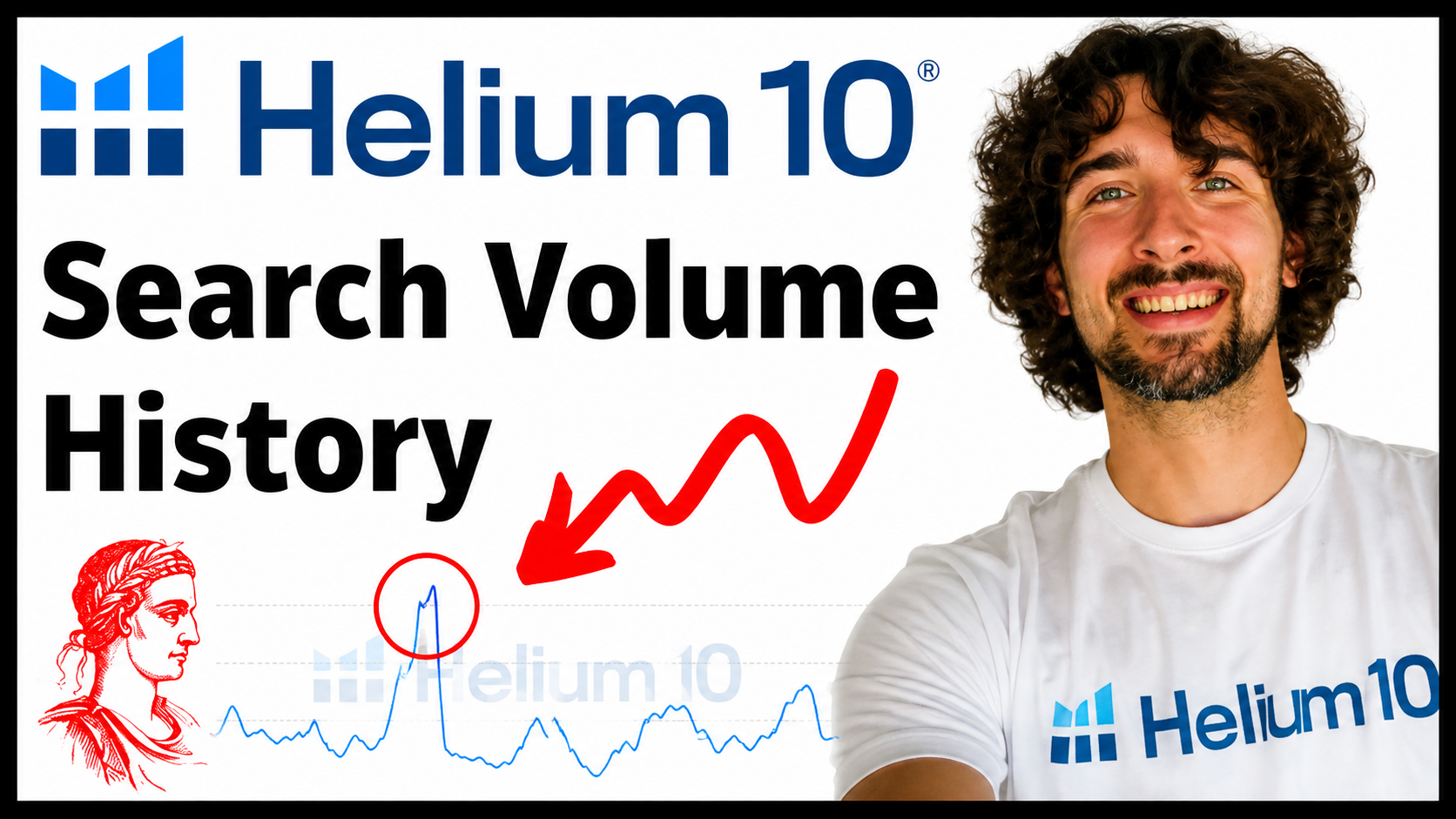
Helium 10 keyword search volume history shows how estimated searches for an Amazon keyword change over time. Open the graph beside Search Volume to explore seasonal peaks, quieter periods, and longer trends. Use those patterns to inform product research, keyword selection, and inventory planning alongside actual sales data.
A product can look exciting in December and much less attractive in February. Before I treat a strong search-volume number as an opportunity, I want to understand what happened before it. Is this normal demand, a recurring seasonal lift, or one unusual spike?
I started selling on Amazon in late 2016, and in the video below I demonstrate this research using “kitchen knife” and “Japanese knife.” The useful lesson is simple: look at the shape of demand before making decisions from one number.
Affiliate disclosure
Some links in this guide are affiliate links. If you purchase through them, I may earn a commission at no extra cost to you. Read my full disclosure.
What does search volume tell you about Amazon demand?
Search volume estimates how often shoppers search a phrase. It does not count unique shoppers, and it does not tell you how many units your product sold. Helium 10’s Cerebro history guide defines the main metric around the previous 30 days. The history chart lets you examine how that measure changes.
This distinction matters. Someone might search “kitchen knife,” compare several listings, search again using a narrower phrase, and leave without buying. More searches can indicate stronger interest, but they cannot establish an exact relationship between searches and orders.
I use the graph to form a question I can investigate. If interest rises before Christmas, could gifting explain it? If interest drops after summer, does that match the product’s use? Then I compare the idea with relevant listings and, when available, my own sales records.
Also keep your marketplace consistent. A seasonal pattern in one country does not automatically describe another. Record the keyword, marketplace, and period together so you can make a fair comparison when you return to the research.
How to find search volume history in Cerebro and Magnet
Start with a keyword when you want to explore shopper language, or a competing product when you want to discover relevant phrases. Both routes can lead you to a keyword’s historical graph. Choose the starting point that answers your immediate question.
- Open Cerebro and select the marketplace. The current documentation uses Cerebro (Plus Magnet). Confirm the country before collecting results.
- Choose your research route. For a seed phrase such as “kitchen knife,” use keyword discovery. The current keyword workflow includes Find Suggestions and Analyze Keywords. For competitor research, use an ASIN lookup.
- Choose a relevant result. Remove phrases that describe another product. A large number is useful only when the shopper’s intent fits what you sell.
- Open the graph beside Search Volume. Review the available date ranges, then inspect the rise, peak, and decline. Widen the view before deciding a recent movement is meaningful.
- Record what you see. Write down the quieter baseline, when interest begins rising, and whether the same pattern appears in earlier periods.
Helium 10’s current keyword-analysis instructions explain the updated screens. Its search-volume history instructions describe views including 30 days, 90 days, one year, and All Time. All Time means the history available for that keyword, rather than a guaranteed start date.
In my recording, the available data reached back to 2019. That is a detail of the demonstration, not a promise that every keyword today has the same history. Check the dates actually shown in your account.
Explore the tools with a free account
Use my Helium 10 link to create an account and review your options. If a paid plan fits your research needs, compare these two coupon offers.
VOVA6M20
20% OFF your first six months.
VOVA10
10% OFF every month, ongoing.
Check eligible plans, feature access, and the applied discount at checkout. A free account does not unlock every research feature.
Get your free Helium 10 account & couponsRead seasonal patterns using the kitchen-knife example
In the video, I search “kitchen knife” and open its historical graph. Interest increases around November and December. I interpret that pattern as consistent with holiday gifting: a useful kitchen product can also become a present.
Next, I use a competing knife’s ASIN in Cerebro and find “Japanese knife.” Its graph shows a broadly similar holiday pattern in the recording. That gives me a second phrase to investigate, rather than relying on one broad term to represent the entire niche.
Those observations belong to the recorded example. They are not current search-volume figures or proof that Christmas caused every movement. Reopen the charts for your target marketplace before applying the pattern to a new product decision.
The July spike is another useful lesson. In the video, I wonder whether Prime Day explains it, but I do not confirm that explanation. Treat an unfamiliar spike as something to research. Check the event dates and surrounding weeks before attaching a story to the line.
| Pattern | Possible meaning | Useful next check |
|---|---|---|
| Similar peaks each year | Recurring seasonal interest. | Compare when the rise begins across years. |
| One short spike | An event or temporary burst of attention. | Investigate the dates and what followed. |
| Steady interest | A potentially stable search baseline. | Check competition and product economics. |
| A sustained decline | Interest may be weakening or shifting. | Compare related phrases and sales records. |
I pay particular attention to the beginning of a seasonal rise. The highest point tells you when interest was strongest. The earlier climb can help you plan when research, listing preparation, and stock availability need attention.
How would I compare a peak with the normal baseline?
Imagine a keyword normally shows about 8,000 estimated searches and reaches 16,000 during a seasonal period. Those invented figures describe a doubling of estimated search interest. They do not justify doubling your inventory. Your share of traffic, conversion rate, and availability may change independently. I would compare several ordinary periods with several seasonal periods before deciding which assumptions deserve further testing.
Keep the comparison consistent: use the same phrase, marketplace, source, and measurement when comparing dates. If you switch to a different keyword halfway through, a higher number could reflect broader wording rather than growing demand. Save enough context with your notes to reconstruct the comparison later.
Use historical demand before committing to a product
A strong month can make a seasonal niche look like a year-round opportunity. If you research Halloween products near their peak, recent numbers may give you a very different impression from a full-year view. Search history helps you see that missing context.
Before contacting suppliers, I would shortlist several phrases that accurately describe the product. I would compare their seasonal shapes, inspect the competing offers, and write down the assumptions behind the opportunity. One popular phrase is a starting point, not a complete market assessment.
For a summer product, investigate both the growth period and the decline. How much of the year appears quieter? Would a delayed shipment leave you holding stock after the useful selling window? Could the same product attract a different use outside that season?
A seasonal product is not automatically a poor choice. It simply needs a plan that reflects its timing. Equally, a stable graph does not prove healthy margins, manageable competition, or room for another seller. Evaluate those questions separately before ordering inventory.
Choose keywords for relevance and timing
The competitor route is useful when you do not yet know which phrases to investigate. In my demonstration, Cerebro surfaces “Japanese knife” from a knife listing. I can then open that phrase’s history or research it directly through keyword discovery.
Before keeping the term, I would check whether it accurately describes my product. A competitor’s keyword list can contain phrases that suit their materials, design, or positioning better than mine. Borrow the research lead; verify the fit for your own offer.
Separate your shortlist into phrases that describe the product throughout the year and phrases tied to a relevant occasion. This helps you plan content and advertising reviews without rebuilding the whole listing around every temporary search increase.
For example, a gifting angle might deserve attention before a recurring holiday rise. It still needs a product and presentation that make sense as a gift. Search history can help with timing, but your listing must explain the product clearly and support its claims.
Before adding a phrase to a campaign, open its Amazon results and ask what a shopper expects to receive. Compare product type, material, size, and intended use with your offer. A seasonal rise in an unsuitable phrase gives you a reason to exclude it, even when the chart looks impressive.
When you revisit the shortlist, keep a short note beside each term: relevant year round, relevant before an occasion, or rejected because the intent differs. That simple record prevents repeated research and makes it easier to explain why a keyword earned its place. You can then evaluate advertising results against a clear initial reason for testing the phrase. Keep the research date beside that note as well. That way, your next review has a reference.
If you want more context on reading the basic metric, use my Amazon keyword search-volume guide. Then watch the additional Cerebro lesson below for the competitor-research approach. Its interface is older, so use the current instructions above to navigate.
Turn seasonal research into a practical inventory plan
Search history can help you anticipate when interest may strengthen or soften. It cannot calculate a purchase order for you. Your sales pace, available stock, incoming shipments, supplier lead times, and cash available all affect the decision.
Start with your own sales history if you have it. Compare periods when the product was in stock and note price changes or promotions. A stockout can make sales look weak even while shoppers are searching heavily, so the sales record needs context too.
Then work backward from when you want sellable inventory available. Allow time for production, inspection, freight, and receiving, plus a sensible delay buffer. The rise in searches is useful only if you connect it to an operational timeline.
Illustrative planning example
Suppose you want inventory ready by September 1. Your assumed production, shipping, and receiving lead time totals eight weeks, and you allow another two weeks for delays. Working backward ten weeks puts the order decision around late June.
These are invented planning assumptions, not Helium 10 measurements or a recommendation for every seasonal product. Replace them with your supplier’s timing and your own risk buffer.
Quantity needs a separate calculation. Estimate the units required over the relevant period, consider safety stock, and subtract usable inventory and confirmed inbound units. Adjust for the seasonal pattern only when your sales evidence supports that adjustment.
Also plan the slowdown. If interest usually declines after the season, a second large order near the peak could arrive too late. Review smaller replenishment options and the consequences of leftover stock before committing.
I would keep a simple decision log: expected demand, assumptions, order date, arrival target, and review date. Compare that plan with actual sales afterward. Over time, those comparisons make your next seasonal decision more useful than copying last year’s order blindly.
Choose the Helium 10 offer that fits your plans
VOVA6M20 gives you 20% off your first six months. VOVA10 gives you 10% off every month, often described as 10% off forever, subject to the offer terms.
VOVA6M20
20% OFF your first six months.
VOVA10
10% OFF every month, ongoing.
Check eligible plans, feature access, and the applied discount at checkout. A free account does not unlock every research feature.
Get your free Helium 10 account & couponsQuestions about Helium 10 search volume history
Is search volume history the same as sales history?
No. It tracks estimated keyword searches over time. A product can receive traffic from multiple phrases and other sources. Use product-level sales records to assess orders, and use search history to understand the demand context around them.
Does All Time include every year since a keyword first existed?
No. It includes the historical data available for that keyword. Check the first and last dates shown. Do not assume another keyword will have the same coverage, or that a short history proves there was no earlier demand.
How often is the historical search-volume data updated?
Helium 10’s history documentation says it adds the previous week’s complete search-volume data at the end of each week. Allow for that reporting lag when investigating a recent event instead of expecting the graph to show live activity.
What is the difference between Search Volume Trend and history?
Trend provides a comparison with the previous month’s search-volume data. History gives you a longer view of the pattern. A positive trend might be a normal seasonal rise, so inspect the chart before treating it as lasting growth.
Can I use the complete feature with a free account?
Create a free account to review the tools and access available to you. Do not assume all historical views or research allowances are included. Confirm the required features in your account and the current plan details before subscribing.
Build your next keyword research session
Choose one product idea, one broad phrase, and two closely related phrases. Open their historical graphs in the same marketplace. Write down when interest rises, how long it stays elevated, and what you still need to verify before acting.
For a wider explanation of the software, the video below is my overview with Bradley Sutton. Treat older screens and plan details as historical; use current documentation for access and navigation.
Free listing optimization course
Continue from keyword research into building a clear, relevant Amazon listing.
Open the free courseMore Helium 10 tutorials
Find additional demonstrations and return to the lesson that matches your next task.
Browse the tutorialsThe habit I want you to build is checking the history before making the commitment. Use the graph to ask better questions, then combine what you learn with product relevance and your business records.
Vova :)