Helium 10 Sales Graph Tutorial: Amazon Sales Trends

In this guide
The quick answer
What is the Helium 10 Sales Graph?
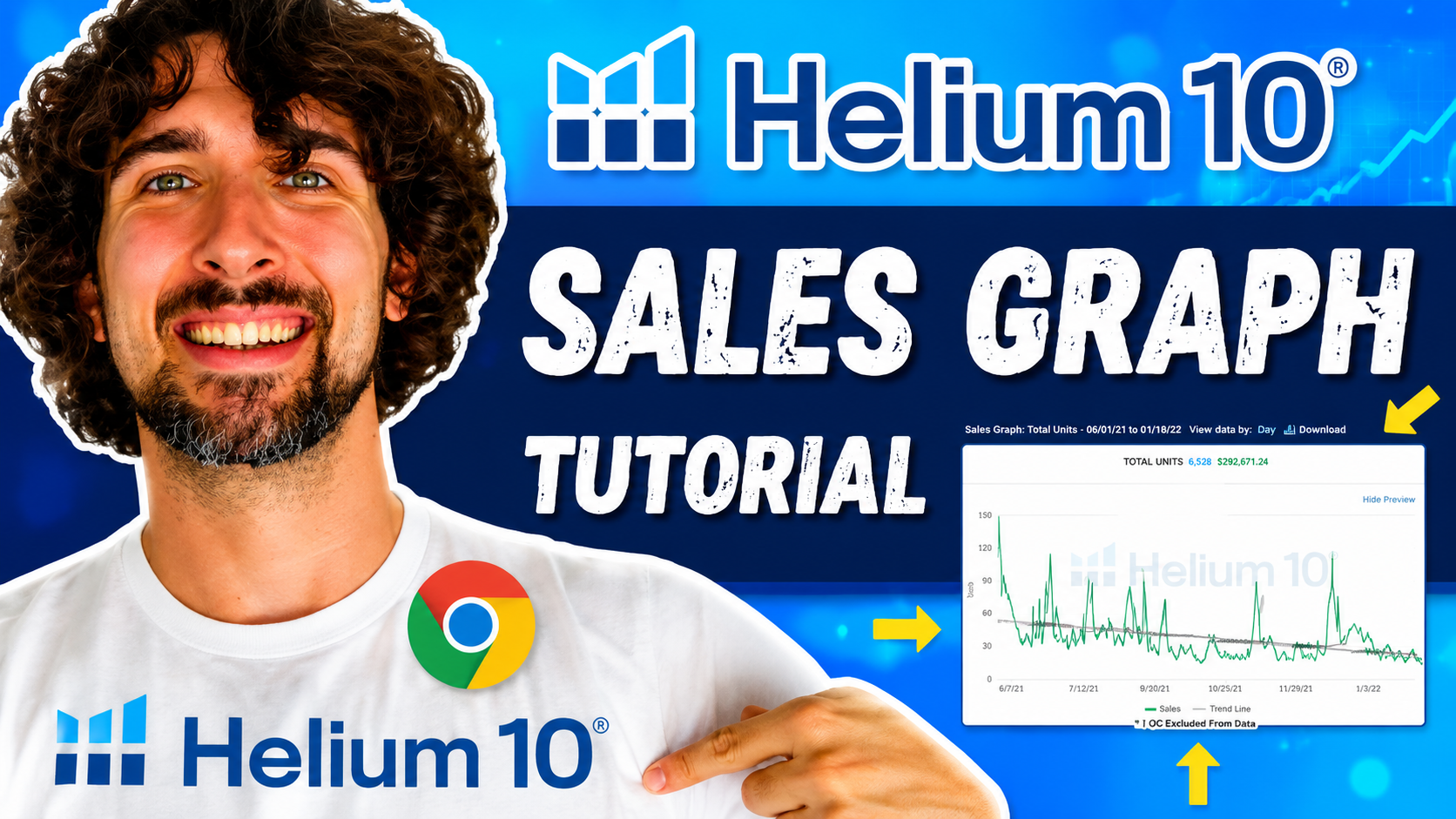
The Sales Graph in Helium 10 Xray shows historical estimated Amazon sales. Its sales line, trend line, and seven-day moving average help you examine fluctuations and longer-term direction. Use the graph to investigate demand and seasonality, then compare competing products before making an inventory decision.
A product can look exciting when you see one strong month. The harder question is whether that month represents normal demand, a short promotion, or the busiest part of its season. That is the question I want you to answer before you commit to stock.
In my Sales Graph tutorial, I explain how to look beyond a single estimate and read the history behind it. This guide expands that lesson into a practical research process, with clearly labeled examples and current documentation where the interface or data interpretation needs extra context.
Affiliate disclosure
Some links are affiliate links. If you purchase through them, I may earn a commission at no extra cost to you. Read my full earnings disclosure.
How to open the Sales Graph in Xray
Start with the official Helium 10 Chrome extension installed in Chrome and sign in to your account. Open an Amazon product page or relevant search results, then launch Xray from the extension menu.
- Identify the product you want to investigate and confirm its ASIN.
- Find the Sales Graph column or chart icon in the product row.
- Open the chart and choose an available date range.
- Inspect individual dates, then compare the short and long views.
Helium 10’s official Xray navigation guide confirms the Sales, Trend Line, and seven-day moving-average views, plus separate BSR and review-count histories. Labels and available history can differ from older recordings.
Before interpreting anything, record the marketplace, ASIN, selected variation, and date range. This takes seconds and prevents a surprisingly common research mistake: comparing two screenshots that describe different products or different periods.
If the graph does not appear, check that you are signed in, the extension is enabled, and Chrome and the extension are updated. Confirm your account’s access before assuming the product has no demand. A missing chart is a technical or data question first.
Follow along with your own product
Use my Helium 10 offer link to explore free-account or trial options, then check the features available for your research.
VOVA6M20
Save 20% off your first six months.
VOVA10
Save 10% off every month.
Check eligible plans, trial availability, and the final discount at checkout. Free installation does not mean unlimited access to every feature.
Explore Helium 10 free access and couponsSales, trend line, and moving average: what each tells you
Read the three views as different lenses on the same history. They help answer different questions; none provides a guaranteed forecast. The comparison below is my suggested way to turn each view into a useful investigation.
| Graph view | How to read it | Useful question |
|---|---|---|
| Sales | Estimated sales at individual points in time. | Is this movement isolated or repeated? |
| Trend line | A summary of direction across the selected period. | Does the broader direction change when I zoom out? |
| Seven-day moving average | A rolling average that smooths daily variation. | Is the recent baseline changing after a spike? |
The daily line is useful when you need to locate an unusual event. If one date stands far above its neighbors, write down the date and investigate what changed. Resist immediately calling it a successful launch, an advertising win, or holiday demand.
The trend line helps you step back. A rising direction can justify more research, but it does not explain why sales improved. A falling direction also deserves context: perhaps the whole niche weakened, or perhaps customers shifted toward competing listings.
A moving average makes the recent pattern easier to follow when daily values jump around. It can also respond slowly to a sudden change because older observations remain in the calculation. Read it alongside the underlying points rather than treating the smoother line as more certain.
My reading order: locate the unusual dates, examine the recent baseline, and then zoom out. A chart becomes more useful when you can explain what question each view helped you answer.
A simple seven-day moving-average example
Here is an invented example to make the calculation concrete. Imagine seven consecutive daily sales estimates of 10, 12, 8, 14, 16, 10, and 14 units. Their total is 84, so the seven-day average is 12 units per day.
84 estimated units ÷ 7 days = 12 units per day
If day eight brings an estimate of 24, drop the oldest value, 10, and add 24. The new seven-day total becomes 98, giving a moving average of 14 units per day.
Notice what happened: the latest daily estimate doubled from the previous seven-day average, while the rolling average moved from 12 to 14. That is the purpose of smoothing. One large day changes the picture without becoming the entire picture.
These numbers are educational, not measurements from the video or an Amazon listing. For a real product, write down whether the increase persists after that unusually strong day leaves the seven-day window. That is a better follow-up question than simply celebrating the initial jump.
There is also a data-handling detail to remember. Helium 10’s Xray documentation says missing points in its moving-average calculation are filled using the most recent available value. A continuous line therefore does not prove that a fresh observation existed for every day.
One extra check helps when the average feels surprisingly high: inspect how concentrated the activity is. In a hypothetical week with six days at 10 units and one day at 80, the total is 140 and the daily average is 20. Yet six of the seven days were below that average. For planning, write down both the typical-looking days and the exceptional day. Then investigate whether the exceptional event is likely to recur during your selling period. This does not replace the moving average; it gives you a clearer description of the observations behind it and the assumptions you are making about demand.
Choose the right date range for the decision
In the recorded walkthrough, I compare shorter windows with longer history. The practical lesson is to change the window deliberately. “All time” should mean the history the tool actually makes available, not a promise of exactly two years for every ASIN.
For a recent change, begin with the shortest useful view and inspect the surrounding dates. For a sourcing decision, widen the window to see whether the attractive period is representative. For a seasonal product, compare corresponding parts of multiple years when enough history exists.
Suppose a product looks strong over the latest month but weak over the preceding nine months. That does not automatically disqualify it. It means your next question concerns timing: will your inventory arrive while that demand still exists?
Reverse the situation and the question changes. A historically steady product might show a weak recent month. Before dismissing it, investigate whether the weakness affected other comparable products, whether the price changed, and whether the listing remained available.
I suggest saving three observations in your research notes: the latest period, the broader pattern, and the biggest unanswered question. This creates a compact record you can revisit after supplier conversations instead of relying on how convincing the graph felt at first glance.
Separate seasonality, isolated spikes, and sustained demand
A repeated peak near the same part of the year is a reason to investigate seasonality. A single spike needs more evidence. Compare dates across products and years before assigning a cause; promotions, availability, and changes in competition can produce patterns that look seasonal.
Consider a hypothetical giftable kitchen accessory. Its chart rises in November and December, then settles down in January. A useful research question is whether several genuinely comparable accessories show the same cycle. If only one listing jumps, investigate that listing’s circumstances.
Now imagine a second product that improves gradually across several months. That pattern may be more compatible with a year-round sales plan, but you still need to understand pricing, customer expectations, and competition. A smooth line alone cannot tell you how difficult entering the market will be.
Seasonal products can suit a business that plans around concentrated demand. The decision depends on your lead times, storage capacity, available cash, and tolerance for leftover inventory. My preference for a beginner is to make those tradeoffs explicit before choosing a product.
Research exercise: a huge holiday peak appears
Write down the peak dates, the level before the peak, and the level afterward. Then inspect three comparable listings over the same dates. Your task is to test whether the pattern repeats, not to turn the best week into a year-round sales assumption.
Keep the research going
If you decide to upgrade after exploring the available tools, compare the two coupon options against your intended subscription period.
VOVA6M20
Save 20% off your first six months.
VOVA10
Save 10% off every month.
Check eligible plans, trial availability, and the final discount at checkout. Free installation does not mean unlimited access to every feature.
Explore Helium 10 free access and couponsCompare several competitors before judging the niche
One popular listing is an incomplete picture of a market. Build a small comparison set around the same customer need, similar product specifications, and a reasonably comparable price range. Exclude obvious mismatches before interpreting the charts together.
For example, a premium branded bundle and a basic single item may attract different customers. Comparing their sales without acknowledging that difference can make the cheaper item look weaker or stronger for the wrong reason. Include pack size, positioning, and review history in your notes.
I suggest starting with five relevant ASINs. For each, record whether the broad pattern looks rising, broadly stable, falling, or strongly seasonal. Add one sentence explaining the evidence and one sentence identifying uncertainty. These are research labels, not official Helium 10 scores.
If four comparable listings weaken during the same period, investigate a shared cause. If four remain steady while one weakens, begin with the outlier. This comparison does not prove causation, but it directs your attention toward a more useful next question.
Also look for a realistic reason a customer would choose your proposed product. Demand for an established brand does not automatically transfer to a new seller. A chart can justify investigating an opportunity; product quality, differentiation, pricing, and execution still determine whether your offer makes sense.
Worked example: two products with similar recent sales
Imagine two candidate products each show an estimated 600 units over a recent 30-day window. The figures below are invented to demonstrate a decision process. They are not live Xray results, forecasts, or recommendations to buy either product.
Candidate A: concentrated demand
Most of the estimated activity falls within a short promotional period. Earlier weeks are quieter, and you cannot yet tell whether comparable listings experienced the same increase. Your supplier could deliver only after the promotion ends.
Candidate B: distributed demand
The estimated activity is spread more evenly through the month. Several comparable listings show a similar pattern over a longer window. However, their established brands and reviews may make winning customers difficult for a new offer.
The matching totals do not create matching opportunities. Candidate A requires a stronger explanation of timing and repeatability. Candidate B requires a stronger explanation of how your offer could compete. Neither question can be answered by multiplying 600 by a selling price.
My next step would be to write a specific evidence request for each. For A: check ordinary weeks and the same season in earlier years. For B: compare the customer experience, product differences, and realistic costs of introducing a new listing.
You may eventually reject both, continue with one, or discover that you need a different comparison set. All three outcomes can be useful. The purpose of research is to improve your decision, including recognizing when the evidence does not support an order.
Understand estimates, BSR, and variation limits
Helium 10 explains that Xray’s sales estimates use Best Sellers Rank in supported main categories, and its monthly sales figure refers to a rolling 30-day period. Treat those figures as estimates, not access to a competitor’s order records. See its sales-estimate explanation.
Sales rank and unit sales are different measurements. The extension’s separate product-page price and BSR chart provides pricing and rank history. Check the chart title and axis before interpreting a number as units sold.
Variations require extra attention. A product family can contain multiple sizes or colors, and standard estimates can reflect shared parent-level information. Do not assign the family’s entire demand to the specific color you want to source, or add repeated family estimates together.
Helium 10 also documents Variation Sales Strength and Recent Purchases for supported access and marketplaces. These offer additional variation context. Recent Purchases reflects customer-purchase data, so it should not be treated as an exact unit-sales ledger.
For your own products, compare research estimates with your actual account reports over matching dates. If they differ, investigate the measurement and period before changing your purchasing plan. Keeping an estimate labeled as an estimate makes your research more useful, not less useful.
Turn the chart into a practical sourcing decision
Once you understand the pattern, write a short decision note. Mine would include the customer problem, relevant competitors, ordinary demand level, seasonal exposure, cost assumptions, and what still needs validation. This prevents an impressive chart from becoming the only argument for a purchase.
Use a conservative scenario, a central scenario, and an optimistic scenario. Keep them separate from the historical graph: these are your planning assumptions. If the opportunity only works under your most optimistic assumptions, identify what evidence would justify that confidence.
Include the time between ordering and having sellable inventory available. A supplier’s production schedule, transit time, and preparation work can move your launch into a different demand period. The question is whether the product makes sense when you can actually sell it.
Then test the economics separately. Estimated sales volume does not tell you what remains after product costs, freight, marketplace fees, advertising, storage, and returns. Use your own figures and current fee information rather than assuming a high-sales listing must leave a healthy margin.
A useful stopping rule: if you cannot explain the demand pattern, your product’s difference, and the assumptions behind your order quantity, keep researching. You do not need a perfect forecast, but you do need a decision you can defend.
When sharing your analysis with a partner or assistant, include the ASIN, marketplace, research date, and chart period beside every screenshot or available export. Separate observations from interpretations. “The estimate increased during these dates” is an observation; “the packaging caused that increase” is a hypothesis requiring more evidence.
Finish by assigning one next action and a review date. You might request a supplier quote, inspect customer complaints, or compare another group of products. Choose the action that resolves your biggest uncertainty. A longer spreadsheet is not necessarily better research if it leaves the same central question unanswered.
Helium 10 Sales Graph: frequently asked questions
Is the Sales Graph the same as the Sales Estimator?
No. The graph helps you inspect historical patterns. The Sales Estimator is a separate extension feature for exploring potential sales and revenue under competitive-offer assumptions. Use the graph when your question is about change over time.
Does an upward trend guarantee that my product will sell?
No. Existing demand is only part of your decision. Your price, product quality, positioning, visibility, and competition affect the outcome. Use the trend as a reason to investigate further, then test whether your proposed offer solves a clear customer need.
Should I avoid every product with seasonal demand?
No. Decide whether its timing fits your business. Consider when you can receive inventory, how much could remain after the peak, and whether off-season demand supports your plan. Recognizing seasonality helps you plan; it does not make the decision for you.
Can I download the extension for free?
The extension is free to install. Feature access and usage limits depend on your account and the current offer. Review Helium 10’s current plans and feature limits before paying for access, and confirm that the research features you need are included.
What should I do when a graph shows a gap or sudden drop?
Check neighboring dates, availability, price context, and comparable listings. A gap is not automatically a day with zero sales. Record what you know and what remains uncertain before treating the change as evidence that the whole niche has weakened.
Explore Helium 10 with my discount codes
Start with one familiar product so you can practice the workflow and decide which features are useful before choosing a paid plan.
VOVA6M20
Save 20% off your first six months.
VOVA10
Save 10% off every month.
Check eligible plans, trial availability, and the final discount at checkout. Free installation does not mean unlimited access to every feature.
Explore Helium 10 free access and couponsContinue learning and put one graph to work
For your next research session, choose one product and answer three questions: what changed, does the pattern repeat across competitors, and what would you need to verify before ordering? That small exercise is more valuable than collecting dozens of screenshots without a decision.
For a broader walkthrough, read my complete Helium 10 Chrome extension tutorial. You can also review my free account and trial guide while comparing access options.
Install the extension
Use the extension link shared with the original tutorial.
Get the Chrome extensionHelium 10 tutorials
Explore more walkthroughs of the tools and their uses.
Watch Helium 10 tutorialsAmazon product research
Continue practicing how to investigate products and competitors.
Watch product research tutorialsTake your time with the first few products. The goal is to build a repeatable habit of asking better questions, checking the evidence, and recording what would change your mind. That is where this graph becomes useful in your Amazon research.
Vova :)