Jungle Scout Chrome Extension Tutorial & Review (2026)

In this guide
The quick answer
How do you use the Jungle Scout Chrome Extension?
Jungle Scout Chrome Extension helps Amazon sellers analyze products directly on Amazon. Install the extension, open an Amazon search results page, and click its browser icon to view estimated sales, revenue, prices, reviews, competition, and product opportunities. Use filters, historical trends, Opportunity Score, and the profit calculator to evaluate products before investing in inventory. Always validate estimates against actual market conditions and your business costs.
Finding a product to sell on Amazon involves more than looking for something popular. You need to understand how many customers may be buying it, how strong the competition is, and whether you can realistically make money after all your expenses.
The Jungle Scout Chrome Extension brings much of that information directly into your Amazon browsing experience. Instead of researching each product separately, you can compare multiple listings, examine historical trends, and identify opportunities worth investigating.
I've been selling on Amazon since late 2016, and product research has been an important part of that journey. In the video below, I walk through the Jungle Scout Extension using kitchen scissors as our example. It's a category I have personally sold in, so I'll also explain why attractive sales figures don't necessarily mean an easy market.
This guide follows that walkthrough from beginning to end, covering the extension menu, research filters, sales estimates, profitability calculations, competitor analysis, and historical graphs. I've also included practical guidance for using those features together and notes where the newer Jungle Scout interface differs from the original recording.
Affiliate disclosure
Some links in this guide are affiliate links. If you purchase through them, I may receive a commission at no additional cost to you. This helps support my free Amazon selling tutorials. Read my full disclosure.
What is the Jungle Scout Chrome Extension?
The Jungle Scout Extension is a browser-based Amazon product research tool. It works alongside Amazon's website and displays additional information about the products you are browsing.
Jungle Scout currently offers its main seller workspace under the Catalyst name. The browser extension is a companion to that workspace, rather than a replacement for everything inside it.
Browser Extension
Research products directly on Amazon, compare estimates, examine listings, and discover opportunities while browsing.
Jungle Scout Catalyst
Use the broader web application for product and keyword research, product tracking, supplier research, and other seller workflows.
The distinction is useful. The extension helps you investigate a product while you're looking at Amazon. Catalyst lets you continue that research through additional tools, including Product Tracker, Keyword Scout, and the Supplier Database.
You can use the extension on supported Amazon search results and product detail pages, along with other supported product-oriented pages. The available information depends on the page, marketplace, subscription, and extension version.
How to download and install Jungle Scout
Before beginning the research, you need the browser extension installed on a desktop or laptop computer. Jungle Scout supports Google Chrome and Mozilla Firefox.
- Open Jungle Scout. Sign in to your account and locate the Extension option in the navigation panel.
- Choose your browser. Select Chrome or Firefox to open the corresponding official browser store.
- Install the extension. Select Add to Chrome or the equivalent Firefox installation option, then approve the browser prompt.
- Pin the icon. In Chrome, open the puzzle-piece Extensions menu and pin Jungle Scout for easier access.
- Sign in and start researching. Visit a supported Amazon product or search page and open the extension.
Installing the browser add-on and purchasing access to its research features are separate matters. Jungle Scout's published membership options include the extension, but the available features and historical-data allowances vary by subscription.
Need help with the installation?
I've prepared a separate walkthrough covering how to download, install, pin, and sign in to the extension.
Read the installation guideYou do not need to connect an Amazon Seller Central account just to research products with the extension. Certain additional seller-account features do require a connection.
Customize the Jungle Scout Extension for product research
Once you open the extension on Amazon, start with its customization options. You can control which information appears, making the research screen easier to read.
In the original video, I begin with the Menu and Customize View options. These let you choose which product data points are displayed and whether certain information appears directly on Amazon pages.
Show sponsored products: I generally prefer to begin my niche research with organic search results rather than mixing them with sponsored advertisements. An advertisement may appear for a broad keyword even when its product is only loosely relevant to the shopper's intent.
You can research sponsored listings separately, but keeping them distinct from organic competitors makes it easier to understand which products Amazon is displaying without that particular paid placement.
Show product information on Amazon pages: The extension can display embedded product cards or graphs directly alongside the listings. I find this useful for quickly checking products without repeatedly reopening the main extension window.
Add or remove data points: You can adjust visible columns, including price, sales, revenue, reviews, rank, and Listing Quality Score. If the table feels crowded, focus on the information needed for your current research question.
For example, if you're evaluating whether a product is economical to ship, prioritize weight, product dimensions, price, fees, and estimated revenue. When investigating competition, reviews, ratings, sales estimates, and seller information become more relevant.
How to filter Amazon products with Jungle Scout
Filtering helps you narrow a search results page into a smaller group of products that fit your research criteria.
In my kitchen scissors example, the extension initially displayed approximately 52 products. I then applied a minimum selling price of $15, reducing the visible group to 14 products.
That simple adjustment allowed us to focus on higher-priced alternatives instead of comparing every inexpensive kitchen accessory. It's especially useful when you're researching a premium product idea.
| Research filter | What it helps you investigate |
|---|---|
| Selling price | Which products compete in your target price range. |
| Monthly sales | Products showing estimated customer demand. |
| Reviews and ratings | Competition strength and possible customer dissatisfaction. |
| Revenue | Estimated gross sales value for competing listings. |
| Weight and size | Packaging requirements and potential fulfillment costs. |
| Seller or offer type | Whether Amazon, FBA sellers, or merchant-fulfilled sellers are competing. |
One important consideration: filtering or removing products changes the group being analyzed. Your averages and Opportunity Score can change as a result. Always remember which listings were included when interpreting a summary.
Jungle Scout special offer
Get the best available Jungle Scout discounts
If you're considering Jungle Scout for your Amazon business, compare the available promotions before subscribing. Discounts can vary by plan, billing period, and seasonal offers.
New subscriptions
Explore introductory deals and compare the available Jungle Scout plans.
Annual and seasonal offers
Check longer-term subscription savings and any active promotional campaigns.
The discounts mentioned in the original video are historical examples, not guaranteed current promotions. Check the price and offer terms at checkout.
Keyword Cloud, CSV exports, and Google Trends
Three useful parts of the original extension walkthrough involve exporting product research, identifying frequently used listing terms, and checking whether interest in a product category changes over time.
Download CSV: In the version demonstrated, Jungle Scout lets you export the product research results into a spreadsheet-compatible file. This is useful if you prefer sorting products in Excel or Google Sheets, comparing categories, or sharing findings with a business partner.
You could sort the file by monthly sales, selling price, review count, or other included fields. Rather than saving hundreds of unrelated products, I recommend keeping a shortlist of promising competitors and writing down why they interest you.
Keyword Cloud: The recording demonstrates a feature that identifies commonly occurring terms in product listings. For kitchen scissors, repeated words included kitchen, scissors, shears, heavy duty, and stainless steel.
Those words tell you how sellers describe their products. They can also suggest features worth researching, such as dishwasher-safe materials, multipurpose designs, or stronger cutting blades.
However, frequency in competitor titles is not the same as Amazon keyword search volume. Use those terms as research ideas, then investigate shopper demand through Keyword Scout. If your current extension doesn't display the older Keyword Cloud control, continue the research through the available keyword tools.
Google Trends: This helps you explore how relative search interest changes over time. In the video, I compare kitchen scissors with fidget spinners to illustrate the difference between an established category and a product that experienced a dramatic popularity spike.
Use Google Trends to investigate longer-term interest and seasonal patterns. Remember that Google search interest is not Amazon order volume, so compare it with actual Amazon marketplace research.
Understanding the Jungle Scout Extension's main metrics
The extension's main table contains different measurements, and knowing what each one represents is essential for making useful comparisons.
| Metric | What it means | How to use it |
|---|---|---|
| Average monthly sales | Average estimated unit sales across the analyzed listings. | Evaluate demand distribution. |
| Average sales rank | Average Best Sellers Rank for the included products. | Compare products within relevant categories. |
| Average price | Average listed selling price. | Explore suitable positioning. |
| Average reviews | Average review count across listings. | Assess established competition. |
| Monthly revenue | Estimated gross sales revenue over a recent period. | Compare the scale of listings. |
| Listing Quality Score | Jungle Scout's estimated listing optimization quality. | Identify listings worth inspecting for improvement opportunities. |
The numbers are not interchangeable. For example, $20,000 in estimated monthly revenue tells you about potential sales value, not the seller's profit.
Jungle Scout explains that its monthly sales estimates are based on the last rolling 30 days and are generated using its estimation engine. They are not direct access to a competitor's private accounting records. You can read the official sales estimate explanation for more details.
How does Jungle Scout Opportunity Score work?
Opportunity Score is Jungle Scout's proprietary way of summarizing the potential of a group of competing listings. It considers factors including demand, competition, seller count, and listing quality.
The score ranges from 1 to 10, where higher generally indicates a more attractive opportunity according to the model.
1–3
Lower opportunity. Demand, competition, or both may make entry less attractive.
4–5
Needs more research. Some products may be worth a closer examination.
6–10
Potentially promising. Investigate the competitors, costs, and customer needs further.
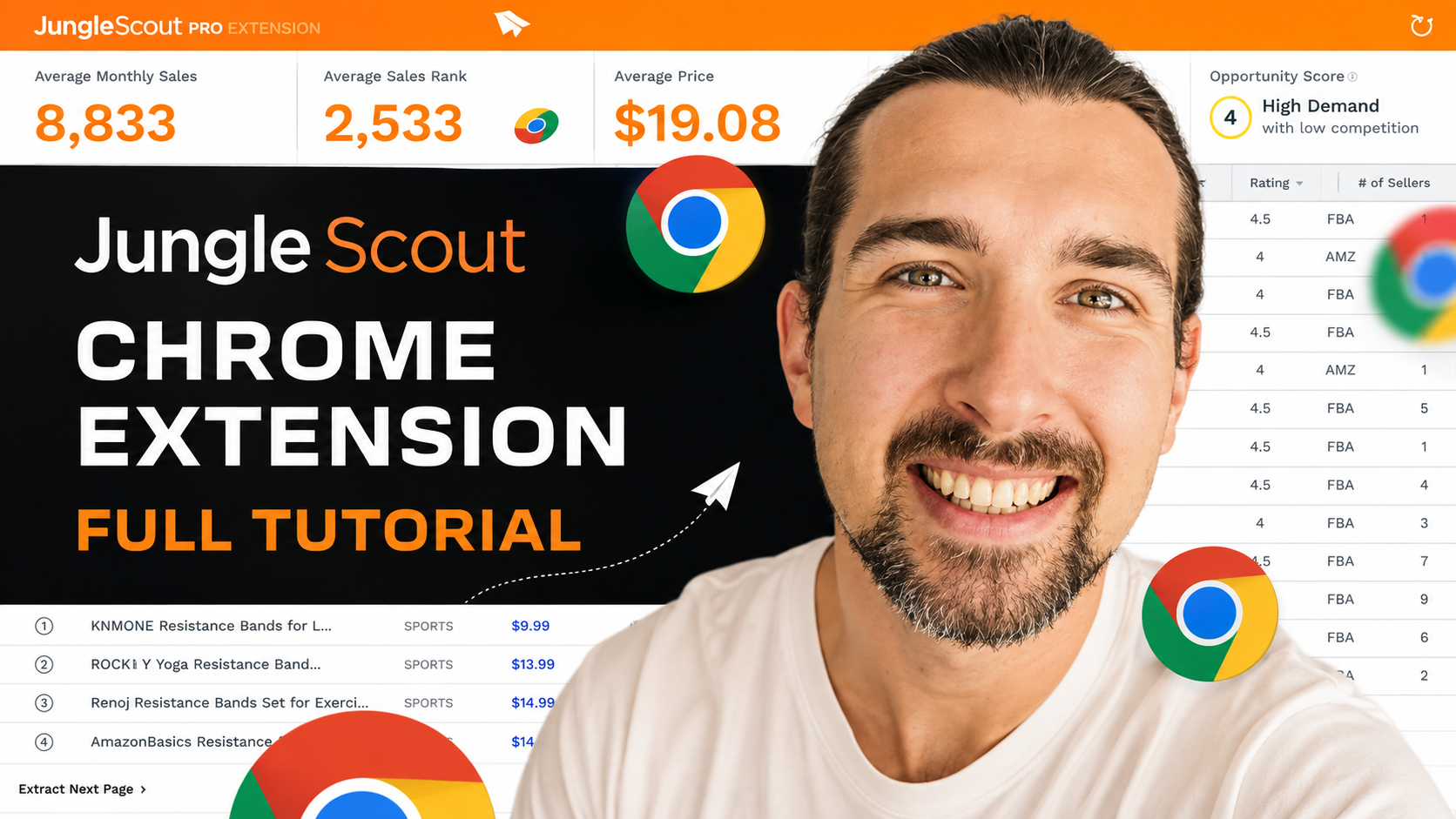
In my original kitchen scissors example, Jungle Scout displayed an Opportunity Score of 4, with relatively high demand but also high competition.
Would I enter that market based only on the score? No. I've sold kitchen scissors, and I know that the category can be very competitive. A successful seller needs more than a favorable-looking average.
My advice: Use Opportunity Score as an initial screening signal. Remove irrelevant listings carefully, inspect the remaining products, and compare the score with real customer problems and your estimated margins. Jungle Scout's official Opportunity Score guide also explains why adding or removing listings changes the result.
How to analyze sales, pricing, and historical trends
Historical trends help you understand whether a product's recent performance looks consistent with its previous activity.
Monthly sales: This metric estimates how many units a product sold during the recent reporting period. Compare multiple competing products instead of relying on one bestseller.
Daily sales: Recent daily estimates can help identify unusual changes. A sudden increase might coincide with a promotion, seasonal event, or increased visibility. A decline might warrant investigating stock availability, price, reviews, or competing offers.
Price history: The historical selling price is particularly useful when evaluating whether a niche appears to be experiencing price pressure. If many comparable products have become cheaper over time, your future margins may face similar pressure.
Best Sellers Rank: BSR is Amazon's sales-based ranking within a category. A lower number generally indicates stronger relative sales performance within that category, but BSR is not a direct unit-sales count and shouldn't be compared indiscriminately across different categories.
The original video illustrates how some kitchen scissors experience sales increases around December. That pattern may suggest gifting or seasonal demand, but one product's history is not sufficient evidence for the entire market.
Important update: Jungle Scout's historical product page graphs can display selected trends such as price, rank, and unit sales. The documented historical graph is not included with the Starter plan. Available lookback periods and other data depend on your subscription and current interface.
For official details about historical metrics, see Jungle Scout's historical graph documentation.
Calculate Amazon FBA profit before choosing a product
One of my favorite practical features in the walkthrough is the FBA Profit Calculator. It helps you move beyond estimated revenue and examine how fees and product costs affect the money left from each sale.
Jungle Scout currently documents access to the calculator through the Net Revenue field in its extension table and Product Database. If that field is hidden, enable it through Customize View.
The calculator can incorporate information such as listing price, dimensions, product weight, Amazon fulfillment fees, referral fees, and your entered product cost. Check and correct the available inputs before trusting the result.
Imagine you're considering a kitchen accessory with the following hypothetical costs:
| Item | Illustrative amount |
|---|---|
| Selling price | $25.00 |
| Referral fee assumption | −$3.75 |
| FBA fulfillment fee assumption | −$4.25 |
| Landed product cost | −$6.00 |
| Advertising allowance | −$3.00 |
| Returns and other variable cost allowance | −$1.00 |
| Estimated contribution per sale | $7.00 |
This example leaves $7 per sale before additional expenses not included in the illustration, such as overhead, storage, taxes, or other applicable costs. It is a planning exercise, not a quote from Amazon or Jungle Scout.
Amazon referral fees vary by product category and sometimes selling price. Similarly, fulfillment charges depend on the applicable size, weight, and fee rules. Never assume that every item carries the same percentage or fixed fulfillment fee.
You can learn how to access the tool through Jungle Scout's FBA Profit Calculator documentation.
Evaluate Amazon competition using reviews, ratings, and listing quality
Understanding competition is about more than checking how many sellers appear on a search results page.
I like to investigate whether products with relatively few reviews are still generating meaningful sales. If several newer or less-established listings appear to be doing well, that can be a useful signal that buyers are willing to consider alternatives.
However, a product having fewer reviews does not automatically make its market easier to enter. A strong brand, patent, distribution advantage, or expensive advertising environment may still make competition challenging.
Ratings provide another angle. Lower-rated products with sustained demand might indicate that customers want a better solution. Read the actual reviews to understand complaints about quality, durability, design, packaging, or performance.
Next, examine Listing Quality Score, or LQS. Jungle Scout grades listing optimization on a scale from 1 to 10 using factors such as titles, bullet points, descriptions, pictures, and image resolution.
A low LQS may suggest the listing could be presented more effectively. But don't mistake an imperfect listing for a weak business. A product may still sell successfully because of customer loyalty, quality, pricing, or brand recognition.
The research question is whether you can deliver a genuinely better customer experience, not merely create a prettier product page. Jungle Scout explains the metric in its official Listing Quality Score guide.
Seller type, Buy Box, product size, and shipping fees
The extension can also help you understand how competing products are being sold and what their physical characteristics imply for your business.
Seller type: Look at whether an offer is associated with Amazon itself, Fulfillment by Amazon, or merchant fulfillment. The featured offer, commonly called the Buy Box, can be shared among eligible sellers over time.
Number of sellers: Multiple sellers on the same ASIN may indicate a wholesale or resale environment rather than a single private-label brand. Check the listing and offer details before drawing conclusions.
Product category: Categories help you understand where Amazon places similar items. BSR comparisons are most meaningful within the same relevant category.
Size and weight: These are especially important for FBA sellers. A small difference in packaging or measured weight can sometimes change applicable fulfillment charges.
My video illustrates how two kitchen scissors listings can have significantly different fulfillment fees because of their recorded size characteristics. The practical lesson is to investigate dimensions and packaging early, then use current Amazon fee calculations to evaluate your actual proposed product.
My step-by-step Jungle Scout product research workflow
Now that we've covered the metrics, here's how I would bring them together into a practical Amazon FBA product research session.
- Start with a specific search phrase. Instead of searching broadly for kitchen products, investigate something like heavy-duty kitchen shears. Make sure the results mostly match the product you intend to research.
- Open the extension and review the competitors. Look at estimated sales, price ranges, reviews, and product types. Keep sponsored placements separate where practical.
- Remove irrelevant products. Exclude accessories or significantly different products that could distort the comparison. Record what you removed.
- Evaluate demand distribution. Determine whether sales appear spread across multiple relevant listings or concentrated among a few dominant brands.
- Read customer feedback. Identify complaints, unmet needs, and features that buyers consistently appreciate.
- Examine historical performance. Check for seasonality, unusual spikes, declining prices, and the stability of demand wherever your subscription provides this information.
- Estimate profit. Obtain realistic sourcing and shipping costs, then calculate fulfillment expenses and an advertising allowance.
- Validate before ordering. Investigate product restrictions, intellectual property issues, suppliers, samples, and realistic inventory requirements.
The extension also provides shortcuts in the original walkthrough for copying an ASIN, adding a product to Product Tracker, researching keywords, and moving into supplier research.
Those connections are useful because product research doesn't stop with discovering an attractive number. Product Tracker can help you evaluate performance over time, while Keyword Scout can help investigate the searches that matter to your intended customer.
Look for sustainable demand
Prefer evidence across several competitors and different periods over a single unusual sales spike.
Look for a genuine improvement
Identify something customers value that your product can deliver consistently and affordably.
For kitchen scissors, that might mean better cutting performance, more comfortable handles, safer storage, or clearer product specifications. Whether any of these creates an opportunity depends on what customers actually say and what competing products already provide.
Using Jungle Scout graphs directly on Amazon
Another convenient feature demonstrated in the video is the ability to view Jungle Scout information without keeping the main extension table open.
On supported Amazon search results pages, embedded product cards can display information such as estimated sales, prices, rank, and other available product details. This makes it easier to scan listings while browsing.
On supported product detail pages, embedded graphs can provide a closer look at trends. You can investigate historical price changes, relative rank, and other available metrics without leaving the listing.
Depending on your plan, the product detail view can also provide additional information about the listing, such as seller count, ratings, dimensions, and recent review patterns.
I generally prefer the main extension table when comparing an entire group of competitors and the embedded product view when investigating one specific listing. You can configure these features through the extension's settings. For more information, see Jungle Scout's embedded product cards guide.
Is the Jungle Scout Chrome Extension worth using?
For Amazon sellers who regularly research competing products, the extension offers a convenient way to compare data without constantly moving between separate browser tabs or manually recording every metric.
I particularly appreciate its combination of estimated sales, competition information, historical context, and profitability tools. Together, they help turn a broad product idea into a more focused research question.
The main limitation is that estimates and scores cannot guarantee future results. The software doesn't know the exact supplier price you'll negotiate, your eventual advertising efficiency, or whether your differentiation will convince customers.
A second limitation is that access varies by membership. A feature demonstrated in an older tutorial might now have a different location, name, or subscription requirement.
My recommendation is to judge the extension by the work it helps you complete. If it helps you evaluate products more systematically, eliminate weak ideas, and identify which opportunities deserve further research, it's providing useful value. If you're not actively researching products, paying for software without a defined purpose may not make sense.
Compare before subscribing
Save on Jungle Scout with my affiliate offer
Ready to explore the extension? Compare the available Catalyst plans, research allowances, historical-data access, and current subscription promotions before making your decision.
Jungle Scout Best Deals
Check the available introductory, annual, and seasonal offers. Confirm your selected plan, final price, and renewal conditions before payment.
Frequently asked questions about Jungle Scout Extension
Is Jungle Scout Chrome Extension free?
The browser add-on can be installed from the supported extension stores, but access to its research features is tied to a Jungle Scout subscription. Check the available Catalyst plans and their allowances before purchasing. Jungle Scout's standard policy provides a seven-day money-back guarantee rather than a conventional free trial.
Can I use Jungle Scout Extension without an Amazon seller account?
Yes. You do not need a connected Seller Central account for the extension's core product research features. You do need the relevant Jungle Scout access. Additional features associated with your own Amazon sales or seller dashboard may require an account connection.
Does Jungle Scout work on Firefox?
Yes. Jungle Scout provides browser extensions for Google Chrome and Mozilla Firefox. Follow its official installation instructions and choose the appropriate browser store.
Can Jungle Scout predict exact Amazon sales?
No. Jungle Scout generates estimates based on available marketplace information and its proprietary models. Those estimates are useful for comparing products, but they are not guaranteed sales figures or predictions of your future performance.
What is a good Jungle Scout Opportunity Score?
Jungle Scout categorizes scores of 6–10 as more promising opportunities worth investigating. However, a high score is not proof that a product is profitable or easy to launch. Product relevance, actual competition, sourcing costs, and differentiation still matter.
Can I use Jungle Scout on my phone?
Jungle Scout's Chrome Extension is intended for supported desktop browsers. Its documentation does not support using the Chrome extension on standard mobile Chrome installations. The web application can be viewed in a mobile browser, although the experience may be less convenient.
Why is my Jungle Scout Extension not working?
Check that you're signed in, using a supported Amazon marketplace, and viewing a suitable product or search page. If the extension remains unresponsive, disable potentially conflicting browser extensions, restart the browser, and consider reinstalling Jungle Scout using its official instructions.
What is the difference between Jungle Scout and its extension?
The extension analyzes products while you browse Amazon. Jungle Scout Catalyst is the wider web application, offering tools for research, keywords, suppliers, listing workflows, and business management. They complement each other rather than serving exactly the same purpose.
Continue learning with my Jungle Scout tutorials
If you'd like to explore the broader Jungle Scout platform after mastering the extension, I've also collected my Jungle Scout tutorials and reviews into a YouTube playlist.
Final thoughts: Use the numbers to make better decisions
Jungle Scout Chrome Extension is most valuable when you understand what the numbers mean and how they connect to a real Amazon business.
Estimated sales help you investigate demand. Reviews and ratings help you understand competition and customer expectations. Historical graphs give context about product performance. The profit calculator helps you explore whether an opportunity is financially realistic.
But none of those features removes the need to investigate the actual product, obtain supplier quotes, assess fees, and understand your customers.
My approach is to use the extension to narrow down possibilities, then spend more time validating the strongest candidates. A good product research decision comes from combining multiple signals rather than trusting a single score.
If you're ready to start researching, explore the Jungle Scout deals shared above, follow the tutorial, and practice with a category you already understand.
I hope this guide helps you make more informed product decisions and avoid some of the expensive mistakes that can come from rushing into an Amazon launch. Wishing you success with your research and your business!
Vova :)