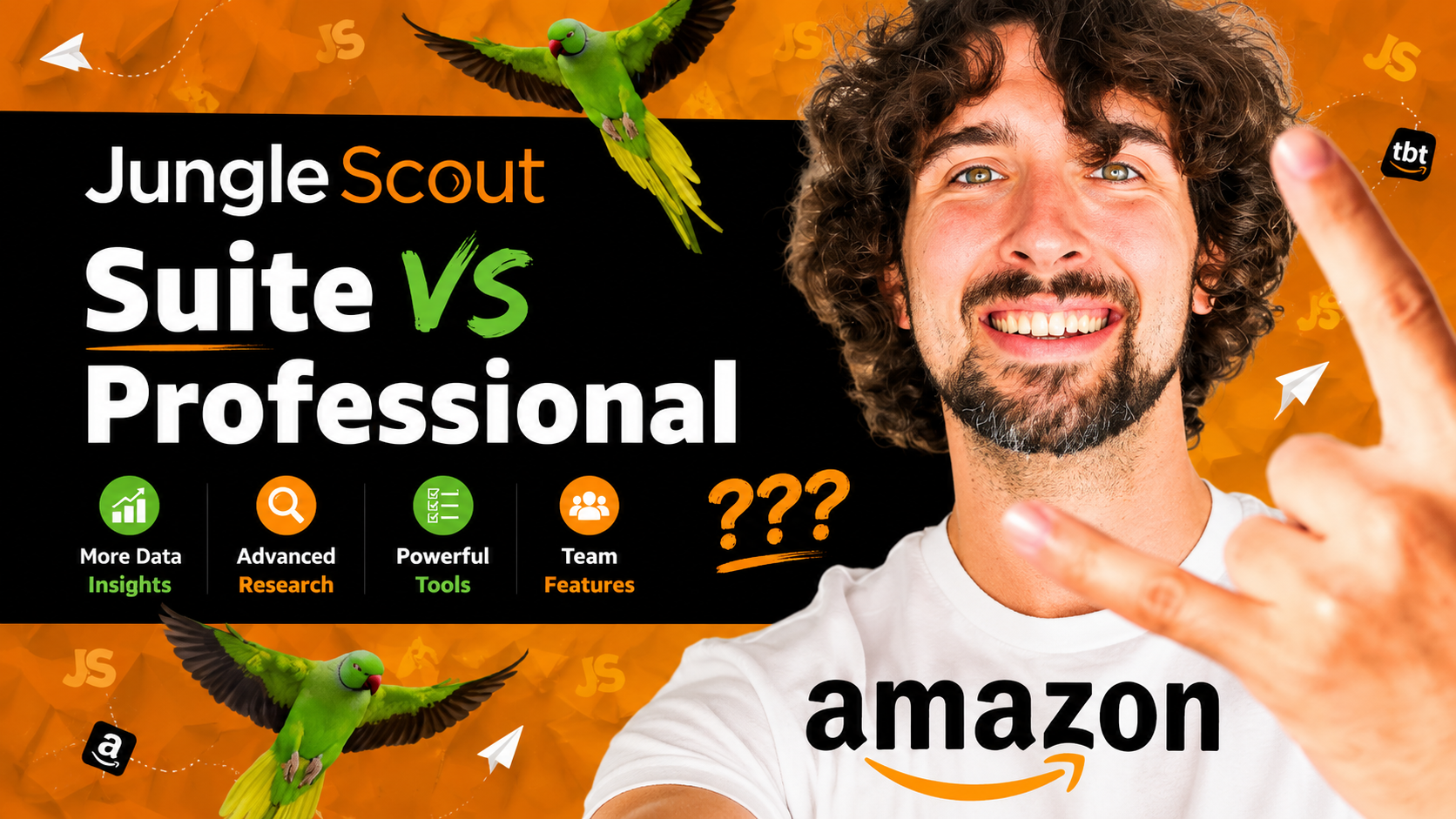
Jungle Scout Suite vs Professional: 2026 Comparison

In this guide
The quick answer
Jungle Scout Suite vs Professional: which is better?
In the original comparison, Jungle Scout Suite was the practical choice for most solo Amazon sellers, while Professional provided more users, deeper historical data, and higher tracking limits. Those are legacy plan names. In 2026, compare Growth Accelerator and Brand Owner within Jungle Scout Catalyst instead. Choose according to your team size, research workload, and the features you will actually use.
When I recorded my Jungle Scout Suite vs Professional review in February 2022, I wanted to answer one question: why pay more for Professional if Suite already handles most of the jobs an Amazon FBA seller needs?
I have sold on Amazon since 2016, and Jungle Scout helped me find my first product, kitchen scissors. That experience shaped the way I approached the video. A bigger feature allowance sounds attractive, but it is only valuable when it makes a real decision easier.
This updated review keeps the original comparison intact while separating the old prices and limits from today's Catalyst subscriptions. You will see what Suite and Professional offered, how their features work in practice, which current plans are closest, and what to check before purchasing.
Affiliate disclosure
Some links in this guide are affiliate links. If you purchase through them, I may earn a commission at no extra cost to you. I share the offers to help you compare your options while supporting my free Amazon selling tutorials. Read my full disclosure.
What was the difference between Jungle Scout Suite and Professional?
Suite and Professional were two subscription levels built around many of the same Amazon research and management tools. Suite focused on providing an affordable, complete working toolkit. Professional added capacity for sellers who needed more history, more keyword monitoring, and several teammates working under one subscription.
In my original walkthrough, both plans included the browser extension, Opportunity Finder, Product Database, Keyword Scout, Supplier Database, sales analytics, listing tools, and product management features. Professional did not suddenly turn these into entirely different products. Its main advantages were higher allowances and additional team access.
| Feature in 2022 | Suite | Professional |
|---|---|---|
| Standard monthly price | $69 | $129 |
| Standard annual price | $589 | $999 |
| Included user seats | 1 | 6 |
| Products in Product Tracker | 150 | 1,000 |
| Monthly sales estimates | 1,000 | 1,500 |
| Historical product tracking | 3 months | 6 months |
| Historical keyword data | 1 year | 2 years |
| Rank Tracker keywords | 3,500 | 5,000 |
| Listing Grader uses per month | 200 | 500 |
| Priority onboarding | Not standard | Included |
These figures describe the video, not a plan you should expect to purchase today. They remain helpful for understanding why Professional was marketed to bigger teams, but current Catalyst allowances need a separate comparison.
Jungle Scout special deals
Compare current offers before choosing a plan
The older video mentions 50% off a first Suite month, limited-time Suite bundles, and discounted Professional yearly packages. Those were offers available at the time, not guaranteed 2026 promotions. My link takes you to the current available deals, where you can compare the actual checkout terms.
See Jungle Scout special dealsJungle Scout pricing in 2026: what replaced Suite and Professional?
Jungle Scout now sells its mainstream Amazon seller tools through Catalyst. The three public plans are Starter, Growth Accelerator, and Brand Owner. Growth Accelerator is the nearest practical comparison to Suite, while Brand Owner occupies the advanced position previously associated with Professional. They are not identical products with a new label: limits and features have changed.
Here are the US dollar prices published on the official Catalyst pricing page, reviewed for this article in November 2026. These are regular advertised prices before special offers, taxes, or optional additions.
| Current plan | Pay monthly | Pay annually | Best starting point |
|---|---|---|---|
| Starter | $49/month | $348/year ($29/month equivalent) | Early product research |
| Growth Accelerator | $79/month | $588/year ($49/month equivalent) | Active solo sellers and small brands |
| Brand Owner + CI | $149/month | $1,548/year ($129/month equivalent) | Established brands needing competitive intelligence |
Annual prices are paid upfront. For instance, $49 per month equivalent on Growth Accelerator means a $588 yearly payment, not twelve individual $49 charges. Cobalt is a separate, custom-priced solution for larger brands and agencies; most new Amazon FBA sellers will first compare the Catalyst options.
A note about included users: Jungle Scout's published pricing comparison and FAQ show inconsistent Brand Owner seat counts. The plan matrix lists three, while its FAQ and support article say ten. If team access is part of your purchase decision, ask support to confirm the seats included in the exact offer you are buying.
Which Jungle Scout features actually matter for Amazon sellers?
A plan comparison becomes useful when it connects features with selling decisions. In the video, I go through more than twenty functions. Here is how I would group the ones that matter most, starting with finding a product and ending with managing it after launch.
Product Database, Opportunity Finder, and the browser extension
Product Database helps you narrow the Amazon catalog by characteristics such as category, price, sales estimates, and competition. Opportunity Finder starts from search opportunities, while the Chrome or Firefox extension brings product information into the Amazon pages you are already browsing. They are different ways of building and checking the same shortlist.
The extension's Opportunity Score can be a useful screening signal, but it is not a verdict that a product will succeed. If an item looks attractive, still investigate demand, fees, seasonality, review quality, differentiation, and sourcing. I would never order inventory because one score looked promising.
The review downloader discussed in the video offers another useful angle: look for repeated complaints and compliments. If buyers praise kitchen scissors for cutting poultry but complain about rust, that may point to both a product-design opportunity and a quality-control requirement. Check that a feature is still available in your selected plan before budgeting around it.
Product Tracker and historical sales estimates
Product Tracker lets you save promising items and examine their performance over time. This makes it easier to distinguish a temporary sales spike from a steadier pattern. The historical lookback is particularly valuable when a category has peaks around holidays, back-to-school periods, or recurring promotions.
Jungle Scout's AccuSales estimates help put potential demand into context. However, an estimated competitor sale is not the same as a verified transaction in your own store. Compare several relevant ASINs, review the available timeframe, and use the numbers to form a research hypothesis rather than a sales guarantee.
Keyword Scout, Rank Tracker, and listing optimization
Keyword Scout helps you discover search phrases and investigate keywords associated with a competing ASIN. If you sell kitchen shears, possible phrases include "kitchen scissors," "poultry shears," and "dishwasher-safe kitchen shears." Each phrase suggests a slightly different buyer expectation, and not every phrase belongs in your listing unless the product really matches it.
Rank Tracker answers a different question: after you launch, are your important keywords becoming more or less visible in Amazon search? Listing Builder helps organize the language you use on a product page. These tools work best together: research what shoppers mean, write accurately for that audience, and measure how the listing performs.
Today's Catalyst plans still include Keyword Scout, but search limits differ. Starter lists 50 monthly searches, Growth Accelerator 250, and Brand Owner unlimited searches on the current feature chart. Do not confuse a search allowance with a number of keywords you may rank for.
Supplier Database and Supplier Tracker
Supplier Database gives you another way to look for manufacturers and identify possible sourcing relationships. Supplier Tracker is useful when you are comparing quotes, minimum order quantities, materials, and lead times. In my video, I use a simple example of three suppliers quoting different per-unit prices.
The cheapest quote may not be the best business choice. Ask about sample quality, packaging, shipping, inspection, payment terms, and production capacity. A supplier appearing in research data does not replace your own verification and due diligence. Current Starter subscriptions do not include Supplier Database; Growth Accelerator and Brand Owner do.
Review Automation, Sales Analytics, and inventory tools
After launch, your challenge shifts from choosing products to running a business. Review Automation helps send Amazon-compliant review requests without relying on your memory to make every request manually. It is not a license to solicit only positive reviews or offer rewards for feedback; review requests must follow Amazon's policies.
Sales Analytics helps you understand revenue and estimated profitability when account data and expenses are complete. Inventory Manager helps you think ahead about demand and replenishment. Imagine selling 100 units per day with 5,000 units available: that covers roughly 50 days, but a 90-day replenishment cycle means you may already be late ordering more. This is a simplified example, not a live inventory forecast.
Alerts, listing analysis, and other management tools can help identify issues before they become bigger problems. I would put more weight on these operational features once you have active products than when you are still deciding whether to sell at all.
Learn the tools before increasing your subscription
I have a free Jungle Scout tutorials and reviews playlist, including product research and tool walkthroughs. You can also read my Chrome extension tutorial and updated Jungle Scout pricing guide.
Watch Jungle Scout tutorialsHow do current Catalyst usage limits compare?
The difference between a low-cost plan and an advanced plan is often less about which button exists and more about how often you can use it. These selected limits come from Jungle Scout's current public Catalyst comparison. They are separate from the historical Suite and Professional numbers above.
| Allowance | Starter | Growth Accelerator | Brand Owner |
|---|---|---|---|
| Product Tracker items | 50 | 150 | 2,000 |
| Historical product data | 30 days | 6 months | 2 years |
| Historical keyword data | 1 month | 1 year | 2 years |
| Sales Estimator per month | 500 | 1,000 | 5,000 |
| Rank Tracker keywords | Not included | 500 | 5,000 |
| Competitive Intelligence | Not included | Not included | Included |
Notice how Growth Accelerator now tracks the same 150 products shown for legacy Suite, but its published historical product data extends to six months. Brand Owner increases both research capacity and market intelligence. That is why the modern plans should be evaluated on their own terms rather than treated as a direct price-for-price replacement.
Plan comparison checkpoint
Pick a plan around your actual workload
Growth Accelerator
A practical starting point for one seller who needs research, listings, supplier data, and day-to-day business tools.
Brand Owner
Worth comparing when a team needs deeper history, many tracked products, and competitive intelligence.
Is two years of historical keyword data worth paying for?
In the video, I liked Professional's two-year history because it helps you put a keyword's growth or decline into perspective. A single year captures one seasonal cycle. Two years can help you ask whether the same pattern repeated, whether a spike was unusual, and whether demand looks stronger or weaker over time.
For example, imagine searches for "holiday kitchen gift set" rise each November. A one-year graph shows the timing; a two-year graph lets you compare the strength of two holiday seasons. If the later peak is smaller, you might investigate changing competition, product tastes, or search language before increasing inventory.
That does not mean two years always produces better decisions. Historical data cannot predict next year's sales with certainty, and a new product category may have very little relevant history. The extra access becomes valuable when you can explain what business decision it changes: sourcing quantity, launch timing, advertising targets, or whether to investigate a niche at all.
Who should choose Starter, Growth Accelerator, or Brand Owner?
Still researching your first product
Start by considering Starter. It gives you basic research access, the extension, and training without paying for advanced seller operations you are not using yet.
Launching or managing a small store
Growth Accelerator is my first comparison for an active solo seller who needs supplier research, review automation, listing workflows, and performance tools.
Managing a larger brand or research team
Brand Owner deserves attention when your portfolio, competitive analysis, or team workload needs its much higher limits. Confirm user seats before buying.
The same reasoning applied to Suite versus Professional: Suite usually covered a smaller seller's workload, while Professional made more sense when several people needed access or research capacity became a bottleneck. The amount of money your store makes is relevant, but your workflow is the stronger starting point.
If you already have a legacy subscription, review your current account rather than assuming you should switch. A grandfathered plan may have different entitlements, and changes can affect your renewal price or access. Ask Jungle Scout support to compare your existing contract with the new plan.
A simple Jungle Scout research test before you subscribe
Before choosing a subscription for a year, try to define a complete research task. I will use the kitchen scissors example from the video because it connects product demand, customer complaints, sourcing, and listings.
- Choose a specific product type. Look at kitchen shears intended for poultry or heavy-duty food preparation, rather than all kitchen equipment.
- Compare several real listings. Use the extension or Product Database to inspect prices, product features, reviews, and estimated demand. Keep the marketplace consistent.
- Check demand over time. Track promising ASINs and inspect the available history. Ask whether sales are seasonal or steady.
- Read reviews for patterns. Record recurring complaints about rust, grip comfort, blade length, or cleaning. Treat these as leads to verify, not proof of widespread product defects.
- Research customer language. Use Keyword Scout to distinguish broad phrases from searches describing your product's real features.
- Compare sourcing and margins. Collect supplier quotes, estimate landed cost and Amazon fees, and consider returns and advertising before calculating potential profit.
- Decide what you actually need next. If the task requires repeat competitor monitoring and analytics, consider Growth Accelerator. If multiple researchers need high limits and competitive intelligence, investigate Brand Owner.
This exercise also helps you evaluate a discount. Paying less for a tool you will not use is not a saving in the practical sense. A plan should fit the work you expect to complete during the subscription period.
Monthly vs annual Jungle Scout billing: which costs less?
Annual billing is cheaper at today's published standard prices, but the savings only make sense if you will use the service long enough. Calculate the full commitment, not just the price shown beside "/month".
| Plan | 12 monthly payments | One annual payment | Annual saving |
|---|---|---|---|
| Starter | $588 | $348 | $240 |
| Growth Accelerator | $948 | $588 | $360 |
| Brand Owner | $1,788 | $1,548 | $240 |
Those calculations exclude coupons, tax, and add-ons. If you are still testing a product idea, the flexibility of monthly billing may be worth more than the theoretical annual saving. If Jungle Scout is already essential to your weekly work, the annual price becomes more compelling.
Is there a Jungle Scout free trial or money-back guarantee?
Jungle Scout does not advertise a standard free trial for Catalyst. Instead, it offers a seven-day money-back guarantee on eligible standard plans. This is not the same thing as getting a free account: you purchase a subscription first, then request a refund within the applicable window if it is not right for you.
Jungle Scout states that a refund is not issued automatically just because you cancel. Contact its support team within the guarantee period, and check the official money-back instructions. Special promotional purchases may have exclusions, so review the terms attached to your exact discount.
You can cancel an ordinary Catalyst subscription to prevent its next renewal, but cancellation does not erase your obligation for the current billing period or automatically trigger a refund. For that reason, I would check the refund terms before making any annual or discounted purchase.
Five mistakes to avoid when comparing Jungle Scout plans
- Treating old discounts as active. My video mentions Suite offers of $34 for the first month, $149 for three months, and discounted annual packages. These illustrate older promotions, not promises that the links still offer those exact terms.
- Assuming all plans include every seller tool. Starter is useful for research, but advanced operations such as Supplier Database, Rank Tracker, and Review Automation require higher Catalyst access.
- Buying based only on the number of features. Two years of history and thousands of tracked products are valuable only when you need that scale.
- Assuming every Amazon marketplace has identical coverage. Catalyst has primary support for several North American and European marketplaces and partial support elsewhere. Verify your specific country and feature.
- Confusing estimates with guaranteed sales. Use product scores and data to focus your research, then validate costs, demand, compliance, competition, and the customer problem independently.
Jungle Scout Suite vs Professional: frequently asked questions
Can I still sign up for Jungle Scout Suite or Professional?
They are legacy plan names. The current public Catalyst checkout lists Starter, Growth Accelerator, and Brand Owner. Existing subscribers should consult their account to understand any legacy entitlements.
Is Growth Accelerator the same as the old Suite plan?
Growth Accelerator is the closest modern counterpart to Suite, but the current feature limits and billing are different. Use the current pricing chart instead of assuming a one-to-one match.
Is Brand Owner better than Growth Accelerator?
It offers more product tracking, longer history, larger research allowances, and Competitive Intelligence. It is the better fit when you need those capabilities. Growth Accelerator may be the better value for a smaller operation.
How many people can use Jungle Scout?
Starter includes one seat and Growth Accelerator includes one seat with paid additional seats available. Brand Owner offers multiple seats, but Jungle Scout's published pages currently disagree about the exact included count. Confirm your checkout terms with support before planning team access.
Does Jungle Scout work outside the United States?
Yes, but coverage depends on the marketplace and tool. Catalyst lists core compatibility for the US, Canada, Mexico, UK, France, Germany, Italy, and Spain, with partial support in other countries. Check the official marketplace support list.
Can I get an extra discount on a Jungle Scout plan?
Eligible offers and seasonal promotions may reduce the regular price. Review my Jungle Scout special deals and confirm the subscription length, renewal price, and refund rules before paying.
Final verdict: which Jungle Scout plan would I choose?
The conclusion of my original Suite vs Professional review still holds: most solo sellers do not need the highest subscription simply because it is available. Start with the tasks you actually perform, then upgrade when a missing feature, research limit, or team requirement starts costing you time or opportunities.
For a seller actively launching and managing products in 2026, I would compare Growth Accelerator first. For a team analyzing many products or needing advanced competitive intelligence, I would evaluate Brand Owner. If you are still learning and have no product, Starter may be enough to begin testing ideas. Choose the workload before the plan.
Your next step
Find the Jungle Scout plan and offer that fit your business
Compare the live plan features with your needs, read any promotion conditions, and decide whether monthly flexibility or an annual commitment makes sense. My special-deals link is available below.
Check Jungle Scout offers